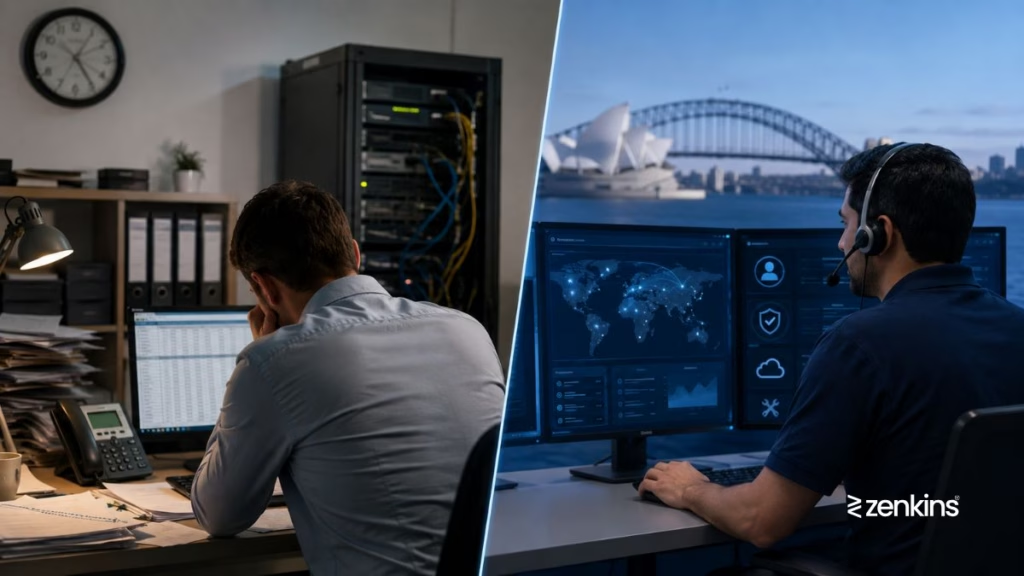
How Managed IT providers ensure continuity during staff changes is a critical concern for organizations that depend on stable IT operations. Employee attrition, role transitions, extended leave, or organizational restructuring can easily disrupt internal IT teams. Managed IT services are specifically designed to absorb these changes without affecting service quality, security, or business productivity.
This knowledge base explains how Managed IT providers ensure continuity during staff changes, detailing the processes, controls, and operational models that keep IT environments stable regardless of personnel movement.
Why Staff Changes Create Risk in IT Operations
Understanding how Managed IT providers ensure continuity during staff changes begins with recognizing the risks of people-dependent IT operations.
Common risks include:
- Loss of undocumented system knowledge
- Delayed incident resolution
- Inconsistent support quality
- Increased security exposure
- Disruption to business-critical systems
Managed IT providers reduce these risks by shifting IT operations from individual dependency to process-driven service delivery.
Process-Driven Service Delivery Model
1. Standardized Operating Procedures
A foundational element of how Managed IT providers ensure continuity during staff changes is the use of standardized processes.
Managed IT providers operate using:
- Documented standard operating procedures
- Defined incident and request workflows
- Clear escalation and approval paths
Because services are process-led, transitions between engineers do not disrupt day-to-day operations.
2. Centralized Knowledge Management
Knowledge centralization is essential to continuity.
Managed IT providers maintain:
- Detailed system documentation
- Architecture diagrams
- Resolution playbooks
- Client-specific business rules
This ensures critical information is retained within the organization rather than with individuals.
Team-Based Support Structure
3. Shared Ownership Model
Another key aspect of how Managed IT providers ensure continuity during staff changes is shared responsibility.
Instead of assigning IT environments to a single individual, managed IT providers use:
- Team-based service ownership
- Role-based access control
- Cross-trained engineers
This eliminates single points of failure caused by employee exits or absences.
4. Built-In Backup Resources
Managed IT providers plan for resource changes by design.
Continuity is maintained through:
- Secondary and tertiary support engineers
- Skill redundancy across teams
- Structured handover protocols
This ensures coverage even during sudden or unplanned staff changes.
Documentation and Transition Readiness
5. Living Documentation Practices
Documentation is continuously updated, not created once.
Managed IT providers:
- Update documentation after every change
- Review documentation during audits and incidents
- Validate accuracy regularly
This practice is central to how Managed IT providers ensure continuity during staff changes.
6. Formal Knowledge Transfer Processes
When staff changes occur, managed IT providers execute structured knowledge transfer.
This includes:
- Handover checklists
- Access validation
- Review of open incidents and changes
Transitions are controlled and auditable rather than informal.
Automation and Monitoring as Stability Anchors
7. Proactive Monitoring Independent of People
Systems are monitored continuously, regardless of staffing changes.
Managed IT providers rely on:
- Automated monitoring tools
- Alert-driven workflows
- SLA-based response mechanisms
This ensures issues are detected and addressed even during team transitions.
8. Automated Remediation and Self-Healing
Automation reduces dependency on individual engineers.
Examples include:
- Service restarts
- Capacity scaling
- Security rule enforcement
Automation plays a major role in how Managed IT providers ensure continuity during staff changes.
Governance, Access, and Security Controls
9. Role-Based Access and Access Reviews
Security continuity is as important as operational continuity.
Managed IT providers enforce:
- Role-based access permissions
- Time-bound access grants
- Immediate access revocation during exits
This prevents both service disruption and security risk during staff transitions.
10. Audit Trails and Accountability
Every action is logged and traceable.
This ensures:
- Operational transparency
- Faster issue investigation
- Compliance with governance standards
Auditability strengthens trust and continuity.
Client Communication and Service Transparency
11. No Dependency on Named Individuals
A defining benefit of managed IT services is continuity without reliance on specific people.
Clients interact with:
- Service desks
- Engagement managers
- Governance frameworks
This ensures consistent communication even when internal staffing changes occur.
Zenkins’ Approach to Continuity During Staff Changes
At Zenkins, continuity is engineered into the service model.
Our approach includes:
- Team-based delivery with skill redundancy
- Centralized and continuously updated documentation
- Automation-driven monitoring and remediation
- Strong governance and access control
This ensures IT operations remain stable, secure, and predictable regardless of staff movement.
Conclusion
Understanding how Managed IT providers ensure continuity during staff changes highlights why managed IT services are inherently more resilient than internally managed, people-dependent IT models.
By combining process discipline, documentation, automation, and team-based ownership, Managed IT providers protect businesses from disruption caused by employee transitions. With the right partner, staff changes become an operational non-event rather than a business risk.