Enterprise Software Development Company in India
Enterprise Software Development Services for Indian and Global Businesses
At Zenkins, we are an enterprise software development company in India offering comprehensive, scalable, and secure software development solutions for large organizations. Headquartered in Ahmedabad, we deliver enterprise software development services in India to enterprises across Ahmedabad, Pune, Bengaluru, Hyderabad, Mumbai, Chennai, Kolkata, Delhi NCR, Noida, Gurgaon, and Kochi — as well as offshore enterprise software development for global businesses across the USA, UK, Canada, Australia, Germany, Netherlands, Singapore, UAE, and Switzerland.
Our enterprise application development services are built to integrate seamlessly with your existing systems, replace rigid off-the-shelf platforms, and support critical business functions — from ERP and CRM modernization to large-scale workflow automation and data platforms.
What Is Enterprise Software Development?
Enterprise software development is the discipline of designing, building, and operating software systems engineered for the demands of large organizations — high transaction volumes, thousands of concurrent users, complex security and compliance requirements, and deep integration with existing infrastructure such as ERP, Active Directory, CRM, and data warehouses.
Unlike software built for small teams or consumer use, enterprise software must guarantee high availability (typically 99.9% uptime or above), support granular role-based access control across business units, produce full audit trails for compliance, and scale horizontally as the organization grows — without architectural rewrites.
As a leading enterprise software development company in India, Zenkins builds enterprise-grade platforms for clients across India and active engagements in the USA, UK, Australia, Canada, UAE, and Germany — platforms that organizations rely on for mission-critical operations.
Enterprise Software Development for Indian and Global Enterprises
Large organizations face a common challenge: off-the-shelf ERP, CRM, and SCM platforms rarely fit how their business actually operates. Zenkins provides custom enterprise software development — building platforms from the ground up or customizing existing systems — to match your processes, compliance requirements, and scale, whether you’re a large enterprise based in India or a global organization looking for an offshore enterprise software development partner in India.
For Indian Enterprises
We work with established businesses across India’s major business hubs — Ahmedabad, Mumbai, Bengaluru, Pune, Hyderabad, Delhi NCR, and Chennai — offering on-site workshops, in-person stakeholder alignment, and direct access to our Ahmedabad-based engineering teams for ERP modernization, custom CRM development, and large-scale process automation. As a local enterprise software development company in India, we understand the regulatory landscape, vendor ecosystems, and operational realities of running enterprise IT in India.
For Global Enterprises
Our India-based delivery teams give you access to senior enterprise architects and engineers through a proven offshore enterprise software development model — at significantly lower cost than building an equivalent team in the USA, UK, Australia, or Europe — without compromising on SOC 2, GDPR, or HIPAA-aligned development practices, and with working hours structured to overlap with your time zone.
Who Needs Enterprise Software Development?
Enterprise software is the right investment when your requirements exceed what off-the-shelf tools can deliver — whether due to scale, security, integration complexity, or the need to own and control your core business systems.
CTOs and VPs of Engineering scaling technology across business units
When a technology platform must serve multiple departments, geographies, or legal entities simultaneously, a custom enterprise solution provides the governance, access control, and data architecture that packaged software cannot. You define the system — not the vendor.
IT Directors replacing legacy core systems
ERP, HRMS, billing, and operations platforms built 10 to 20 years ago accumulate technical debt that eventually blocks growth and creates compliance risk. Our enterprise application development services modernize these systems — migrating functionality to modern architecture while preserving institutional business logic and data integrity.
Operations leaders automating complex workflows
When approval workflows, procurement processes, compliance reporting, or customer operations involve multiple systems and human handoffs, a purpose-built enterprise application eliminates friction, reduces error rates, and produces the audit evidence required for regulated industries.
Finance, healthcare, manufacturing, and regulated industries
Organizations in regulated sectors need software that can demonstrate compliance — GDPR in the EU and UK, HIPAA in the USA, SOC 2 for US enterprise clients, RBI and SEBI guidelines for Indian BFSI enterprises, and ISO 27001 for global operations. We build compliance controls into the architecture from day one, not as an afterthought.
Enterprise Software vs Custom Software vs Off-the-Shelf
| Enterprise Software | Custom Software | Off-the-shelf |
Target user base | 1,000 – 100,000+ users | 10 – 5,000 users | Any (generic) |
Integration complexity | Enterprise-grade (SAP, Oracle, AD) | Moderate | Limited |
Compliance built-in | Yes — SOC 2, GDPR, HIPAA | On request | Rarely |
High availability SLA | 99.9%+ uptime design | Standard | Vendor-controlled |
Role-based access | Multi-tier RBAC | Basic | Basic / none |
Audit logging | Full audit trails | Optional | Not available |
Data governance | Full control | Partial | No control |
Scalability | Horizontal + vertical | Vertical | Fixed / limited |
IP ownership | 100% client-owned | 100% client-owned | Vendor-owned |
Off-the-shelf tools work well for generic functions. Enterprise software development is the right investment when scale, security, integration complexity, or competitive differentiation are non-negotiable requirements.
Our Enterprise Software Development Services
Zenkins delivers the full spectrum of enterprise application development services — from greenfield platform builds to modernization of aging core systems, for both Indian enterprises and global businesses outsourcing development to India.
Custom Enterprise Application Development
We design and build enterprise applications tailored to your organization’s exact operational requirements — workflow engines, internal platforms, approval systems, multi-entity management tools, and operational dashboards. Engineered for the scale, security, and reliability that enterprise environments demand.
Enterprise Resource Planning (ERP) Development
We build custom ERP systems and implement ERP integrations for organizations that need more control than SAP or Oracle offer out of the box. Our ERP solutions cover financial management, procurement, inventory, production, HR, and cross-functional reporting — built on your data model, not a generic schema.
CRM Platform Development
We develop enterprise CRM platforms that integrate with your sales, marketing, support, and finance systems. Whether replacing Salesforce due to cost or building capabilities it cannot support, our CRM solutions are built for your sales process and reporting requirements — not a one-size-fits-all template.
Enterprise Portal and Intranet Development
Employee portals, customer portals, partner portals, and supplier portals built with role-based access, single sign-on (SSO), document management, and workflow integration. Designed to handle thousands of concurrent internal users across business units and geographies.
Data Platform and Business Intelligence Systems
We build enterprise data platforms — data warehouses, data lakes, ETL pipelines, and embedded analytics dashboards — that consolidate data from across your technology estate into a single, governed source of truth. Integrated with Power BI, Tableau, or custom analytics for decision-maker reporting.
Workflow and Process Automation Platforms
Replacing manual, email-based, or spreadsheet-driven processes with rule-based workflow engines. We build approval systems, compliance workflows, document routing platforms, and cross-departmental automation tools that reduce processing time and generate audit-ready records.
Enterprise Mobile Application Development
Legacy Enterprise System Modernisation
Migrating enterprise applications from end-of-life architectures to modern, cloud-ready platforms. We re-platform, refactor, or rebuild legacy ERP, CRM, and operations systems while preserving business rules, historical data, and continuity of operations throughout the transition.
Enterprise API Development and Integration
AI-Powered Enterprise Applications
Embedding artificial intelligence and machine learning into enterprise platforms — predictive analytics, natural language processing for document handling, anomaly detection in operational data, intelligent process automation, and AI-assisted decision support systems built directly into your enterprise workflows.
Ready to Build Enterprise-Grade Software That Scales With Your Business?
Partner with a reliable enterprise software development company in India to design, develop, and deploy custom enterprise software solutions aligned with your operations, growth goals, and digital transformation strategy — whether you’re scaling locally in India or outsourcing development offshore.
Our Enterprise Software Development Process
Enterprise Discovery
Solution Architecture
UI/UX for Enterprise
Agile Sprint Delivery
Enterprise QA & Security
Deployment & Integration
Training & Change Management
Support & Optimisation
Technology Stack
Mobile
React Native, Flutter, Swift (iOS), Kotlin (Android)
Databases
Microsoft SQL Server, PostgreSQL, MySQL, Oracle DB, MongoDB, Redis, Elasticsearch
Cloud and infrastructure
Microsoft Azure, AWS, Google Cloud Platform — multi-cloud and hybrid architectures
Enterprise integrations
SAP, Oracle ERP, Salesforce, Microsoft 365 / Active Directory, ServiceNow, Workday, REST/GraphQL/SOAP/gRPC APIs
DevOps and CI/CD
Docker, Kubernetes, Terraform, Ansible, GitHub Actions, GitLab CI, Jenkins, ArgoCD
Security
OWASP, multi-factor authentication, RBAC, AES-256 encryption, SIEM integration, penetration testing
Monitoring & observability
Datadog, Prometheus, Grafana, ELK Stack, Azure Monitor, AWS CloudWatch
AI / ML add-ons
Azure OpenAI, OpenAI API, TensorFlow, PyTorch, Power BI embedded analytics
Our Enterprise Software Development Teams — India and Worldwide
India — Enterprise Software Development Company
As an Ahmedabad-headquartered enterprise software development company in India, we serve enterprise clients across Bangalore, Pune, Mumbai, Hyderabad, Delhi NCR, and Chennai. Our India enterprise clients benefit from on-site capability for critical phases, direct access to the engineering team, local regulatory familiarity (RBI, SEBI, GST-linked systems), and the ability to scale teams quickly within a single engagement.
USA — Offshore Enterprise Software Development to India
We serve US-based enterprises across financial services, healthcare, manufacturing, logistics, and SaaS. Our US enterprise engagements follow SOC 2-aligned development practices, include HIPAA-aware engineering for healthcare data, and are supported by project managers available during Eastern and Pacific business hours. Many US clients use Zenkins as their offshore enterprise software development partner for platform builds that would be cost-prohibitive with US-only engineering teams.
UK, Europe & Switzerland — Offshore Enterprise Software Development to India
UK and European enterprise clients benefit from GDPR-compliant development practices embedded at the architecture level — data residency, consent management, right to erasure, and privacy-by-design. We serve clients in the UK, Germany, Netherlands, and Sweden across financial services, retail, and professional services.
Australia, Singapore & APAC — Offshore Enterprise Software Development to India
Our Australia and Singapore enterprise clients operate in financial services, healthcare, and government-adjacent sectors. We provide dedicated solution architects and project managers aligned with AEST and SGT working hours, and our delivery teams are experienced with Australian Privacy Act (APA) compliance requirements.
Canada & UAE — Offshore Enterprise Software Development to India
We have active enterprise software engagements in Canada, the UAE, Germany, and the Netherlands. Our delivery model supports clients in these markets with dedicated project leads, structured reporting, and contractual IP protection under the applicable legal framework.
Industries We Serve
Enterprise software requirements differ significantly by industry. Our cross-sector experience — across both Indian and global markets — means we arrive at each engagement with relevant domain knowledge, reducing the time spent explaining your business context and increasing the quality of the solution architecture.
Financial services, banking, and fintech
Trading platforms, core banking system integrations, regulatory reporting tools, risk management dashboards, loan origination systems, and compliance-first data platforms. Built to meet FCA, SEC, RBI, MAS, and AUSTRAC requirements depending on your operating market.
Healthcare and life sciences
Patient management platforms, clinical data systems, telehealth infrastructure, laboratory information management systems (LIMS), and healthcare analytics tools. Built with HIPAA compliance for US clients and NHS data standards for UK healthcare organisations.
Manufacturing and Industry 4.0
Production management platforms, supply chain visibility systems, IoT data integration layers, quality management systems, and ERP integrations for smart manufacturing environments. Connecting shop-floor operations with enterprise data infrastructure.
Retail, ecommerce, and consumer goods
Omnichannel commerce platforms, inventory and order management systems, loyalty and CRM programmes, supplier portals, and demand forecasting tools for retail organisations managing large product catalogues and complex fulfilment operations.
Professional services — consulting, legal, and accounting
Client and matter management platforms, time-and-billing systems, document management with access controls, compliance reporting tools, and business development CRM platforms built for the operational requirements of professional services firms.
Telecommunications and media
Billing and customer management platforms, network operations tools, subscriber portals, content delivery infrastructure, and operational analytics systems for telecommunications providers and media companies.
Energy, utilities, and infrastructure
Asset management systems, operational monitoring platforms, regulatory compliance tools, and field workforce management applications for energy and infrastructure organisations managing complex physical assets and regulatory reporting obligations.
Why Choose Zenkins for Enterprise Software Development?
The difference between a successful enterprise software project and a costly one is rarely the technology. It is the quality of the requirements process, the rigour of the architecture, the consistency of the delivery team, and the depth of post-launch support. Here is what we bring to enterprise engagements — for clients in India and around the world:
Senior-led delivery throughout the engagement
Enterprise projects at Zenkins are led by a senior solution architect and a dedicated delivery manager with enterprise project experience. The team that presents the proposal is the team that builds the solution. No bait-and-switch with junior staff after contract signature.
On-ground presence in India, global delivery standards
As a locally headquartered enterprise software development company in India, we offer in-person workshops, faster escalation, and a team that understands Indian business operations, vendor ecosystems, and regulatory context — combined with the process discipline and compliance rigour expected by our global clients.
Full IP ownership — no exceptions
All source code, documentation, architecture diagrams, database schemas, and associated intellectual property are transferred to the client on project completion and final payment. Your enterprise software is an asset you own outright. No licence dependency, no lock-in.
Security and compliance by architecture
Security controls — RBAC, encryption, MFA, audit logging, OWASP compliance, penetration testing — are designed into the architecture during phase one. Compliance with GDPR, HIPAA, SOC 2, ISO 27001, and Indian regulatory frameworks (RBI, SEBI) is built in, not retrofitted at the end.
Integration capability
Enterprise environments are complex. Most projects require integration with at least five to ten existing systems. Our solution architects have deep experience with SAP, Oracle, Salesforce, Microsoft 365, Active Directory, and a wide range of industry-specific platforms — and we design integrations that are resilient, observable, and maintainable.
Transparent governance and communication
Enterprise clients have multiple stakeholders. We establish a governance model that works for yours — weekly steering updates, monthly executive summaries, shared project dashboards, and direct access to the technical lead. No surprises, no information silos.
Post-launch SLA and long-term partnership
Our enterprise support model includes response SLAs, performance monitoring, proactive security patch management, and a quarterly roadmap review. Many of our enterprise clients have been with us for three or more years because we treat the relationship as a long-term partnership, not a project transaction.
Case Studies & Success Stories
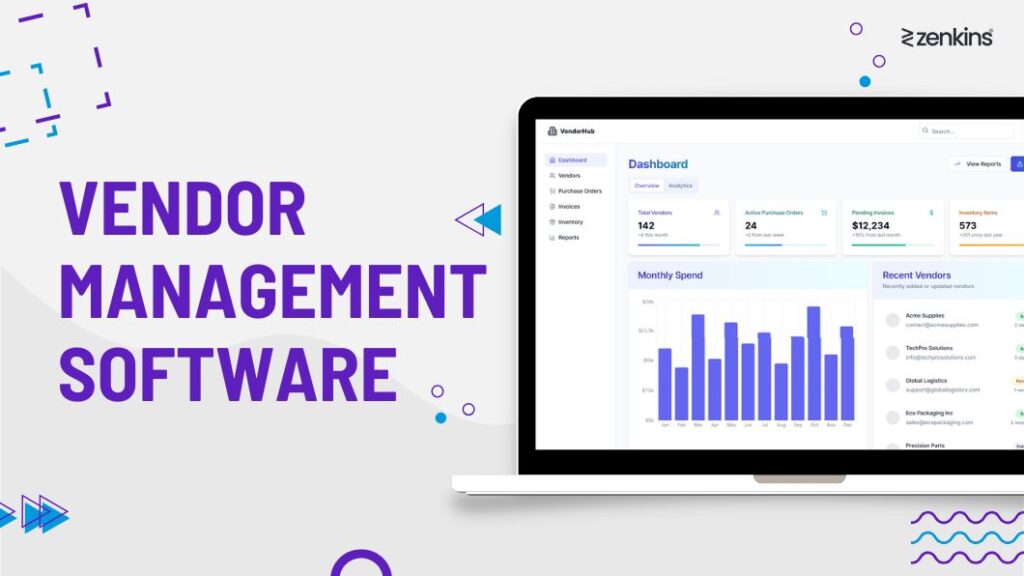
Ultimate Vendor Management Software: Streamline Operations & Cut Costs by 50%

Manufacturing ERP Software Solutions: A Case Study

Telemedicine Platform for Remote Patient Care: A Case Study
Ready to Start Your Enterprise Software Project?
Whether you’re a business in India looking for a trusted enterprise software development company, or a global organization exploring offshore enterprise software development in India, Zenkins brings the architecture, engineering, and process discipline that enterprise projects require.
No commitment required — we’ll scope the fit first.
Explore Our Latest Insights

How Much Does Custom AI Agent Development Cost in 2026? A Pricing Guide for Business Leaders
Custom Software Development vs. Extending Your Team (2026)

How to Hire Developers Without a Technical Co-Founder: A Non-Technical Founder’s Guide to Vetting Talent
FAQs About Enterprise Software Development
Get clear answers about enterprise software development services, including timelines, costs, technologies, and how the right enterprise software development company in India can help you build scalable and future-ready systems.
What is enterprise software development?
Enterprise software development is the process of designing, building, and deploying large-scale software systems built specifically for organizations with complex operations, high user volumes, deep integration requirements, and strict compliance needs. Enterprise software typically includes ERP systems, CRM platforms, workflow automation tools, data platforms, and custom operational applications. Unlike off-the-shelf software, enterprise applications are engineered to the organization’s exact requirements, scale with the business, and are owned outright by the client.
How much does enterprise software development cost in India?
The cost of enterprise software development services in India varies depending on factors such as project complexity, number of integrations, number of user roles, and the technology stack used.
For Indian enterprises: a mid-scale enterprise application typically ranges from ₹40 lakh to ₹1.5 crore, while large, multi-module ERP or CRM platforms can range from ₹1.5 crore to ₹5 crore or more.
For global enterprises: a mid-scale enterprise application typically ranges from USD 60,000 to USD 250,000, while large, multi-module ERP or CRM platforms can exceed USD 500,000.
We offer a detailed quote after an initial consultation and requirement analysis.
How long does enterprise software development take?
A focused enterprise module or workflow platform typically takes 6 to 12 months. Comprehensive multi-module enterprise platforms with extensive third-party integrations typically require 12 to 24 months. Projects with phased releases can deliver value earlier — a first production release in 4 to 6 months is achievable for well-defined scopes. We provide a milestone-based project plan with firm delivery dates at the end of the discovery phase.
What is the difference between enterprise software and custom software development?
Custom software development refers to building any software tailored to a specific business, from a small internal tool to a large platform. Custom enterprise software development is a subset of custom development, but it specifically addresses the demands of large organizations: high concurrency, multi-level role-based access control, compliance and audit requirements, integration with complex enterprise systems, high availability architecture, and governance frameworks. Enterprise software is distinguished by its scale, security depth, and the number of stakeholders it serves.
How does Zenkins ensure compliance with GDPR, HIPAA, SOC 2, and Indian regulations?
Compliance requirements are captured during the discovery phase and translated into architecture decisions — data residency, encryption standards, access control design, audit logging, and data retention policies. For GDPR, we implement privacy-by-design including consent management, right-to-erasure workflows, and data processing records. For HIPAA, we engineer access controls, encryption at rest and in transit, and audit trails to BAA-compatible standards. For SOC 2, we align development and operational practices with the relevant trust service criteria. For Indian enterprises, particularly in BFSI, we design systems with RBI and SEBI guidelines in mind. We work with your legal and compliance team throughout.
Can Zenkins integrate enterprise software with our existing ERP, CRM, and legacy systems?
Yes. Integration is central to enterprise software delivery. We have built integration layers connecting custom enterprise applications to SAP S/4HANA, Oracle ERP Cloud, Salesforce, Microsoft Dynamics, Workday, ServiceNow, Active Directory, and many industry-specific platforms. We design integrations using REST, GraphQL, SOAP, gRPC, and event-driven patterns, and we build resilient middleware where direct API integration is not available. All integrations are documented and observable from day one.
Does Zenkins provide offshore enterprise software development for businesses outside India?
Yes. Zenkins is a trusted offshore enterprise software development partner for enterprise clients across the USA, UK, Australia, Canada, UAE, Germany, Netherlands, and Sweden. Our delivery model is fully remote with structured communication — dedicated project managers, weekly reporting, and shared project dashboards. We have experience with the compliance requirements of each major market we serve. Many international clients choose Zenkins specifically because our India-based engineering teams deliver enterprise-quality work at competitive rates, managed by client-facing leads in their time zone.
Does Zenkins serve enterprises based in India directly?
Yes. As an Ahmedabad-headquartered enterprise software development company in India, we work directly with enterprises across Bangalore, Mumbai, Pune, Hyderabad, Delhi NCR, Chennai, and other major Indian business hubs. Indian clients benefit from on-site workshops, in-person stakeholder alignment, and faster turnaround due to shared time zones and local presence.
Who owns the intellectual property of the enterprise software Zenkins builds?
The client owns all intellectual property. Upon project completion and final payment, Zenkins transfers full ownership of the source code, documentation, database schemas, architecture specifications, and all associated IP to the client. This is stated explicitly in the project agreement. There are no ongoing licence fees and no vendor lock-in of any kind.
What post-launch support does Zenkins offer for enterprise software?
Zenkins provides SLA-backed post-launch support covering bug resolution, performance monitoring, security patch management, infrastructure oversight, and user support escalation. Support is available at Tier 1/2/3 levels depending on your requirements. We conduct quarterly roadmap reviews to plan feature development, performance improvements, and technology upgrades. Many enterprise clients retain Zenkins on an annual support and enhancement contract following the initial delivery.
Can you modernize our existing legacy enterprise system?
Yes. We have delivered numerous legacy enterprise modernization projects — re-platforming monolithic applications to microservices architecture, migrating from on-premises to cloud, upgrading end-of-life technology stacks, and rebuilding outdated UI layers while preserving backend business logic and data. Our approach prioritizes zero-downtime migration strategies, data integrity validation, and parallel running periods to ensure operational continuity throughout the transition.
What engagement model does Zenkins use for enterprise software projects?
We offer three engagement models for enterprise work. Fixed price is suited for well-defined projects where scope and requirements are clear before development begins. Time and materials is suited for complex projects where requirements are expected to evolve — common in large enterprise transformations. Dedicated team is suited for ongoing platform development where the client needs a stable, embedded engineering team working continuously on the product. We recommend the appropriate model based on your project’s nature during the initial consultation.