Python Django Development Company
High-performance Python backend solutions with Django and Flask for scalable applications.
A Python Django development company is a software engineering firm that builds web applications, REST and GraphQL APIs, SaaS backends, AI-integrated platforms, and data-driven systems using Python and the Django framework — alongside FastAPI for high-performance async APIs and Flask for lightweight services. Zenkins is a Python Django development company based in India delivering Python solutions for web, SaaS, AI integration, and data engineering — for clients in the USA, UK, Australia, Canada, UAE, and India.
Python in 2026 — Why It Is the Language of Both Web Development and the AI Era
Python has held the top position in the TIOBE Index and IEEE Spectrum language rankings for several consecutive years — driven not just by web development adoption but by its unassailable dominance in artificial intelligence, machine learning, and data engineering. Every major AI framework — TensorFlow, PyTorch, scikit-learn, LangChain, LlamaIndex — is Python-first. The OpenAI API, Anthropic Claude SDK, Google Gemini SDK, and Hugging Face Transformers library are all Python-first. When a company wants to integrate LLM capabilities into their product, the implementation is almost always Python.
For web and API development, Python’s versatility is expressed through three mature frameworks that serve distinct needs. Django provides a batteries-included approach — ORM, admin panel, authentication, form handling, and an extensive ecosystem — that is ideal for full-featured web applications and admin-heavy SaaS products. FastAPI provides modern, async-first API development with automatic OpenAPI documentation, type-safe request and response validation via Pydantic, and near-raw performance for high-throughput API workloads — including serving machine learning models. Flask provides a minimal, composable approach for lightweight services, microservices, and situations where Django’s opinions would be constraints.
The result is that in 2026, a Python development company is not just a web backend shop. It is a partner that can build your Django-powered SaaS platform, your FastAPI endpoints for serving AI models, and your LangChain-based RAG system — all in the same language, often in the same project, often by the same developers. Zenkins is that company.
Zenkins is a Python Django development company based in Ahmedabad, India, with over a decade of Python development across Django web applications, Django REST Framework APIs, FastAPI microservices, and Python-based AI/ML integration. We serve clients in financial services, healthtech, SaaS, e-commerce, and logistics across the USA, UK, Australia, Canada, UAE, and Germany.
Django vs FastAPI vs Flask — Which Python Framework Is Right for Your Project?
| Django | FastAPI | Flask |
Approach | Batteries-included | Modern, async-first | Minimal / micro |
Async support | Partial (ASGI in 3.1+) | Excellent (native async) | Partial (via extensions) |
Auto API docs | No | Yes (Swagger + ReDoc) | No |
Type hints / validation | Moderate | Excellent (Pydantic) | Manual only |
ORM built-in | Excellent | None (SQLAlchemy typical) | None (SQLAlchemy typical) |
Admin panel | Excellent | No | No |
Auth & permissions | Built-in | Manual only | Manual only |
Performance (raw) | Good | Excellent | Good |
Learning curve | Moderate | Low-Moderate | Lowest |
Community & ecosystem | Most | Growing | Mature |
Best for | Full web apps, CMS, admin portals, SaaS | AI APIs, high-perf microservices, ML serving | Lightweight microservices, prototypes |
When Zenkins recommends Django
When Zenkins recommends FastAPI
When Zenkins recommends Flask
What We Build with Python — Use Cases and What Each Involves
Python use case | Typical technologies | Zenkins delivers |
Django web application | Django 5.x, DRF, Wagtail, PostgreSQL, Celery, Redis | Full-featured web platforms, admin portals, SaaS backends |
FastAPI REST / AI API | FastAPI, Pydantic, Uvicorn, SQLAlchemy, asyncpg | High-performance APIs, AI model serving endpoints, async microservices |
Django REST Framework API | DRF, JWT / DRF Simple JWT, drf-spectacular, Celery | Mobile backends, SPA backends, B2B API platforms |
AI / LLM integration layer | FastAPI, LangChain, LlamaIndex, OpenAI API, Anthropic SDK | AI-powered features in existing products, RAG systems, agentic workflows |
Machine learning pipeline | scikit-learn, XGBoost, PyTorch, MLflow, Airflow, Feast | Model training pipelines, feature engineering, model serving APIs |
Data engineering pipeline | Apache Airflow, dbt, Pandas, PySpark, SQLAlchemy, Prefect | ETL/ELT pipelines, data warehouse automation, analytics data prep |
Flask / lightweight service | Flask, Flask-RESTful, Marshmallow, SQLAlchemy | Microservices, internal tools, API adapters for legacy systems |
Automation & scripting | Python stdlib, Playwright, Selenium, Requests, paramiko | Test automation, web scraping, workflow automation, system integration |
Django CMS / content platform | Wagtail, django-cms, Mezzanine, headless delivery via DRF | Content-driven platforms, editorial workflows, headless CMS APIs |
Our Python Django Development Services
Zenkins delivers the full spectrum of Python development — from Django web applications and REST APIs to FastAPI microservices, AI/LLM integration layers, and data engineering pipelines.
Custom Django Web Application Development
Full-featured Django web applications following Django’s recommended app structure with clean separation of models, views, serializers, and URL routing. We implement Django’s class-based views for standard CRUD operations and function-based views where logic is too complex for a generic mixin. Django’s admin is configured and extended — not left at its default — to provide a genuinely useful internal operations tool. Applications are deployed on Gunicorn with Nginx on AWS, Azure, or GCP, with Redis-backed caching and Celery for background task processing.
Django REST Framework API Development
REST APIs built on Django REST Framework — the de facto standard for Django API development. We follow a contract-first approach using drf-spectacular to generate OpenAPI 3.x documentation before implementation begins. Serialiser design, ViewSet vs APIView decisions, DRF permission classes, throttling configuration, pagination, filtering with django-filter, and JWT authentication with DRF Simple JWT are standard on every DRF project. For APIs that need to serve multiple consumer types (mobile app, SPA, partner integration), we design for API versioning from day one.
FastAPI Development — High-Performance Async APIs
Modern, async-first API development with FastAPI — including automatic OpenAPI and ReDoc documentation, Pydantic v2 model validation, dependency injection for shared services and database sessions, async database access with asyncpg or SQLAlchemy 2.0 async, background task handling with asyncio or Celery, and JWT authentication with python-jose. FastAPI is our recommended framework for AI/LLM API endpoints, model serving APIs, and high-concurrency microservices where async performance matters.
AI and LLM Integration with Python
Integrating artificial intelligence and large language model capabilities into existing products and new platforms using Python’s AI ecosystem. We build: retrieval-augmented generation (RAG) systems using LangChain or LlamaIndex with vector databases (Pinecone, Chroma, or pgvector); LLM-powered API endpoints using FastAPI + OpenAI / Anthropic / Google Gemini SDKs; agentic workflows with LangGraph or CrewAI; document processing and extraction pipelines; and AI-powered features embedded in Django applications (intelligent search, content generation, classification).
This is an area of rapidly growing demand — clients who previously engaged Zenkins for Django web development are now returning to add AI capabilities to their existing Python platforms, and new clients are specifically looking for Python shops with LangChain and FastAPI experience. Zenkins bridges both.
Machine Learning Pipeline Development
End-to-end ML pipeline development — feature engineering, model training with scikit-learn, XGBoost, PyTorch, or TensorFlow, experiment tracking with MLflow or Weights & Biases, model packaging and versioning, and model serving via FastAPI or cloud-native serving infrastructure (SageMaker, Azure ML, Vertex AI). We do not build research models — we build the engineering infrastructure that takes a data scientist’s prototype model and makes it production-ready, observable, and maintainable.
Data Engineering with Python
Python-based data pipeline development using Apache Airflow for orchestration, dbt for SQL transformation layers, Pandas or Polars for in-memory data transformation, and SQLAlchemy for database connectivity. We build ETL/ELT pipelines that move data from source systems (application databases, third-party APIs, flat files) into data warehouses (Snowflake, BigQuery, Redshift), implement data quality checks with Great Expectations, and deploy pipeline infrastructure as code on AWS MWAA or self-managed Kubernetes.
Django CMS Development with Wagtail
Wagtail CMS development — custom page types with StreamField blocks, custom image renditions, editorial workflow configuration, search integration with Elasticsearch or the built-in Wagtail search, headless content delivery via the Wagtail Content API, multi-site configuration, and Wagtail version migrations. Wagtail is our recommended CMS for Python/Django teams because it is Django-native, developer-friendly, and actively maintained. We also migrate from older Django CMS systems (Mezzanine, django-cms) to Wagtail where clients need a more modern editorial interface.
Python Django Application Modernisation
Modernising older Python and Django applications — upgrading from Django 2.x/3.x to Django 5.x, migrating from Python 2 to Python 3 (still required for some legacy systems), refactoring monolithic Django applications into service-oriented architectures, replacing synchronous Celery-heavy workflows with async FastAPI microservices, and migrating from deprecated libraries (South migrations to Django built-in migrations, tastypie to DRF, requests to httpx for async support).
Python Backend Support and Maintenance
Long-term maintenance for production Python Django applications — Django and Python version upgrades (Django 4.x → 5.x, Python 3.10 → 3.12), security dependency patching (critical given Python’s vulnerability to transitive dependency CVEs), performance investigations (slow QuerySets, N+1 problems, Celery backlog issues), Sentry error monitoring configuration, and feature development retainers. We take over maintenance of Python applications from previous developers and have a structured technical audit process for new codebases.
Ready to Build with Python Django?
Partner with a Python Django development company to develop fast, secure, and scalable web applications tailored to your business goals and growth plans.
Our Python Development Process
Discovery & framework selection
API contract & data model design
Security architecture
Development — agile sprints
Background tasks & async
Testing — comprehensive
AI/ML integration (where applicable)
Deployment & CI/CD
Monitoring & maintenance
Technology Stack
Core language
Python 3.11 / 3.12 / 3.13, type hints (mypy), async/await, dataclasses, Pydantic (v2)
Web frameworks
Django 5.x (primary full-stack), FastAPI (async / AI APIs), Flask (lightweight), Starlette (ASGI base)
API layer
Django REST Framework (DRF), drf-spectacular (OpenAPI docs), FastAPI (native OpenAPI), GraphQL (Strawberry, Graphene-Django), gRPC (grpc-python)
ORM & data access
Django ORM (QuerySet, select_related, prefetch_related), SQLAlchemy 2.x (Core + ORM), asyncpg (async PostgreSQL), Tortoise ORM (async), Alembic (migrations)
Databases
PostgreSQL (primary), MySQL, SQLite, MongoDB (PyMongo / Motor), Redis, Elasticsearch, DynamoDB, BigQuery, Snowflake
Authentication
Django Auth, DRF Simple JWT, python-jose, PyJWT, OAuth2 (Authlib), django-allauth, social-auth-app-django, Keycloak integration
AI & LLM
LangChain, LlamaIndex, OpenAI Python SDK, Anthropic SDK, Hugging Face Transformers, LangGraph, CrewAI (agentic), FAISS / Chroma / Pinecone (vector DBs)
ML & data science
scikit-learn, XGBoost, LightGBM, PyTorch, TensorFlow/Keras, Pandas, NumPy, Polars, Matplotlib / Seaborn, MLflow, Weights & Biases
Async & task queue
Celery (with Redis / RabbitMQ broker), Django Q, Huey, Dramatiq, Python asyncio, HTTPX (async HTTP client)
Data pipelines
Apache Airflow, Prefect, dbt (data build tool), PySpark, Great Expectations (data quality), Feast (feature store)
CMS
Wagtail (primary — Django-native, headless via API), django-cms, Mezzanine
Cloud & infra
AWS (Lambda Python runtime, ECS, RDS, SQS, S3), Azure (App Service, Functions, Azure OpenAI), GCP (Cloud Run, Cloud Functions, Vertex AI), Docker, Kubernetes
DevOps & CI/CD
GitHub Actions, GitLab CI, Docker, Kubernetes, Terraform, uv / pip / Poetry (dependency management), pre-commit hooks, SonarQube
Testing
pytest (primary), pytest-django, factory_boy, Faker, pytest-asyncio, httpx (async test client), Locust (load testing), OWASP ZAP (security)
Code quality
mypy (type checking), ruff (linting + formatting), black, isort, bandit (security linting), SonarQube, coverage.py
Python Django Development for Global Businesses
USA — Python Django development company
UK and Europe — Python Django development company
Australia — Python Django development company
India — Python Django development company
Canada, UAE, and other markets
Industries We Serve
Financial services and fintech
Trading platform backends, lending management systems, personal finance management apps, payment processing services, insurance policy management, and regulatory reporting pipelines. Python's pandas and NumPy are standard in financial data processing; Django REST Framework is the most common API layer for fintech web platforms; FastAPI is increasingly used for real-time pricing and market data APIs.
Healthcare and life sciences
Patient management platform backends, clinical data processing pipelines, telehealth API services, health and wellness app backends, and clinical trial data management systems. Python's FHIR libraries (fhir.resources, hl7apy) are used for healthcare interoperability; Django provides the application backbone; FastAPI serves the real-time health monitoring data endpoints.
AI and machine learning products
Model serving APIs, RAG system backends, document intelligence platforms, AI-powered search systems, recommendation engine APIs, and natural language processing pipelines. This is the fastest-growing segment of Zenkins Python work — driven by demand for LangChain, LlamaIndex, FastAPI, and vector database expertise that emerged from the LLM revolution of 2023–2025.
E-commerce and retail
Django powers several well-known e-commerce platforms (Saleor, the open-source headless commerce platform, is Django-based). We build custom e-commerce backends, order management systems, product catalogue APIs, and inventory management tools in Django and FastAPI.
SaaS and product companies
Django is the most common Python framework for SaaS backends because of its ORM, admin panel, and batteries-included approach. We build multi-tenant Django SaaS platforms, subscription management with Stripe, usage metering with Celery, and customer-facing REST APIs with DRF.
Data engineering and analytics
Python is the dominant language for data engineering. We build Apache Airflow DAGs for data orchestration, dbt projects for SQL transformation layers, Python ETL scripts with Pandas and Polars, and data quality pipelines with Great Expectations — typically serving data warehouse targets on Snowflake, BigQuery, or Redshift.
Education and e-learning
Django's admin panel and ORM make it a popular choice for e-learning platform backends — course catalogue management, student progress tracking, assignment submission and grading, and LMS API development. We build Wagtail CMS integrations for content management and DRF APIs for mobile learning app backends.
Why Choose Zenkins as Your Python Django Development Company?
Full Python spectrum — web, APIs, and AI in one team
Type-safe Python as standard — not optional
Django ORM performance — the most common production failure mode
Celery configuration that actually works in production
AI-ready Python architecture
Ready to Start Your Python Project?
Whether you are building a new Django web application, scaling an existing Python backend, adding AI and LLM capabilities to your product, or looking for a Python development partner for a long-term engagement — Zenkins has the Python depth across web, API, and AI to deliver it.
We serve Python clients in the USA, UK, Australia, Canada, UAE, and India. Every engagement starts with a technical discovery call — we will assess your requirements, review any existing codebase, and give you an honest framework recommendation, timeline, and cost estimate.

Explore Our Latest Insights
How to Choose a Software Development Outsourcing Vendor for ERP, Web, and Custom Development (Without Overpaying)
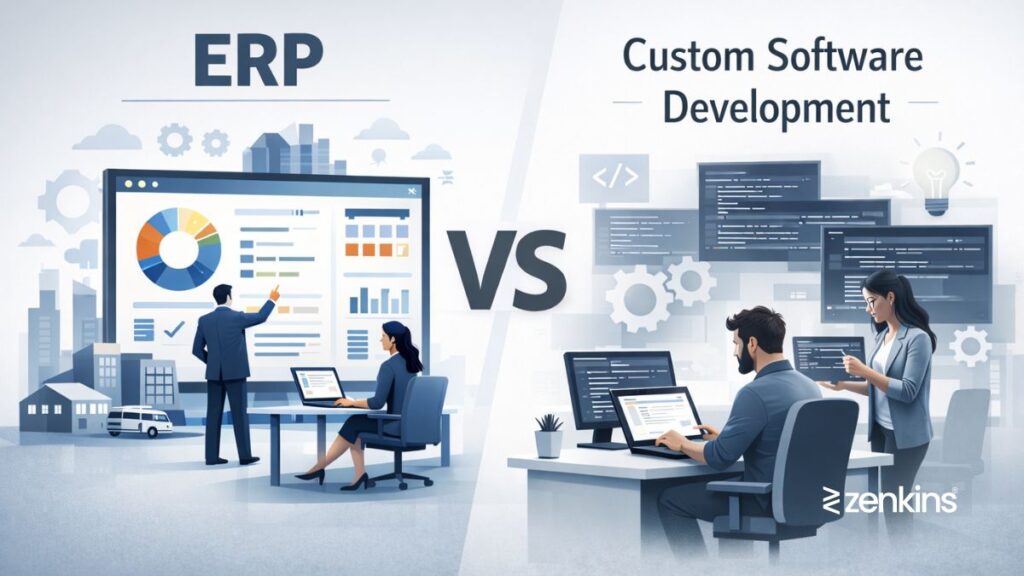
ERP vs Custom Software Development in 2026: Which Scales Better for Growing Businesses?

Trusted .NET Development Company in Hyderabad 2026 for HealthTech and Life Sciences
Frequently Asked Questions
What is Django and why is it used for web development?
Django is a high-level Python web framework that follows the ‘batteries included’ philosophy — it provides an ORM for database access, a URL routing system, template engine, form handling, built-in authentication, a powerful admin panel, and a comprehensive security framework out of the box. This means Django developers can build functional, production-ready web applications significantly faster than frameworks that require assembling these components individually. Django is used by major organisations including Instagram, Disqus, Pinterest, and Mozilla because its opinionated structure enforces consistency in large codebases, and its ORM’s QuerySet API is one of the most productive database access layers in any language.
What is the difference between Django, FastAPI, and Flask?
Django is a full-featured framework — it includes an ORM, admin panel, authentication, form handling, and template engine. It is ideal for full web applications and SaaS backends where you need a rich set of built-in capabilities. FastAPI is a modern, async-first API framework with automatic OpenAPI documentation and Pydantic-based type-safe validation — ideal for high-performance APIs, AI/ML model serving endpoints, and microservices. It does not include an ORM or admin panel. Flask is a minimal framework that provides URL routing and request/response handling only — you assemble the rest from extensions. It is ideal for lightweight services and situations where Django or FastAPI’s opinions would be constraints. The right choice depends on your use case: Django for feature-rich apps, FastAPI for performance-sensitive APIs and AI backends, Flask for lightweight services.
How does Python integrate with AI and large language models?
Python is the primary language for AI and LLM development because every major AI library and SDK is Python-first. For LLM integration, the most common tools are: LangChain (for building chains and RAG systems that combine LLM calls with retrieval from vector databases), LlamaIndex (specialised for document indexing and retrieval-augmented generation), the OpenAI Python SDK and Anthropic Python SDK (direct API access to GPT-4 and Claude), and Hugging Face Transformers (for open-source model inference). FastAPI is the standard framework for exposing these capabilities as HTTP API endpoints because of its async performance and automatic documentation. Vector databases (Pinecone, Chroma, pgvector for PostgreSQL) store the embeddings used by RAG systems. Zenkins builds production-grade AI integration layers that include caching, rate limiting, cost monitoring, and structured output validation.
What Python version should we use for new projects?
Python 3.12 is the current stable release with strong performance improvements over 3.11. Python 3.13 was released in October 2024 and is stable for most use cases. Django 5.x requires Python 3.10 as a minimum and runs well on Python 3.12. FastAPI and most modern Python libraries support Python 3.10+. For new projects in 2026, targeting Python 3.12 provides the best balance of performance improvements (15-60% speed improvement over Python 3.10 in many benchmarks), library compatibility, and LTS-like stability before the full ecosystem migration to 3.13 is complete. Avoid Python 3.9 and earlier for new projects — they are end-of-life or approaching it.
How much does Python Django development cost?
Python Django development cost depends on the application type, feature complexity, integrations, AI components, and team size. A focused Django REST API or admin application typically ranges from USD 20,000 to USD 60,000. A full Django web application or SaaS backend with authentication, background tasks, and third-party integrations typically ranges from USD 50,000 to USD 180,000. A complex AI-integrated Python platform with FastAPI, LangChain, vector database, and data pipeline components ranges from USD 80,000 to USD 350,000 or more. Zenkins provides detailed proposals after an initial scoping call.
What is Django REST Framework and when should I use it?
Django REST Framework (DRF) is the standard library for building REST APIs with Django. It provides serialisers (which handle the conversion between Django models and JSON), ViewSets (which reduce API boilerplate by combining CRUD operations), authentication classes (JWT, session, token), permission classes, throttling, pagination, and filtering. DRF is the right choice when: you are already using Django as your application framework and need to expose an API (for a mobile app, SPA, or third-party integration); you want to reuse your Django models and business logic in an API without duplicating code; or your API is predominantly CRUD operations over a Django data model. For high-performance, async-native APIs where you are not starting from an existing Django application, FastAPI is a better choice.
Do you do Python development for businesses outside India?
Yes. Zenkins serves Python Django and FastAPI clients in the USA, UK, Australia, Canada, UAE, and Germany. Our India-based Python engineers deliver Django web applications, DRF APIs, FastAPI microservices, and LangChain AI integration for international clients with full GDPR, HIPAA, and APA compliance capability. Many international clients choose Zenkins specifically because India has the largest pool of experienced Django and FastAPI engineers in the world, and Zenkins can place senior Python architects and engineers at 50 to 65 percent of equivalent US or UK market rates without quality or communication compromise.
What is Wagtail CMS and should my Django project use it?
Wagtail is an open-source CMS built on Django — it provides a modern editorial interface for managing content, a flexible StreamField API for modular page content, image management with focal point cropping, full-text search, and a headless Content Delivery API for serving content to decoupled frontends. Wagtail is the recommended CMS for Django projects that need a content management layer because it is Django-native (reuses your Django models, ORM, and templates), developer-friendly (it does not fight your architecture), actively maintained, and widely adopted. It is used by NASA, Google DeepMind, CalTech, and many government and media organisations. Zenkins recommends Wagtail for Django projects that have significant editorial content management requirements and want a CMS that can grow with the application.