
Table of Contents
Introduction: Hire Desktop Engineers L1 vs L2
In today’s digitally dependent business environment, reliable IT support is more than a necessity—it’s the backbone of smooth operations, productivity, and customer satisfaction. Companies rely on desktop engineers to manage day-to-day IT issues, support end-users, and ensure business continuity. However, when organizations decide to hire desktop engineers L1 vs L2, they often wonder:
- What’s the difference between L1 and L2 desktop engineers?
- Which one does my business need?
- How can the right combination reduce downtime and improve efficiency?
This blog answers those questions in detail and provides a comprehensive guide to hiring desktop engineers L1 vs L2, including their key differences, roles, responsibilities, and the business benefits of building the right IT support structure.
What are Desktop Engineers?
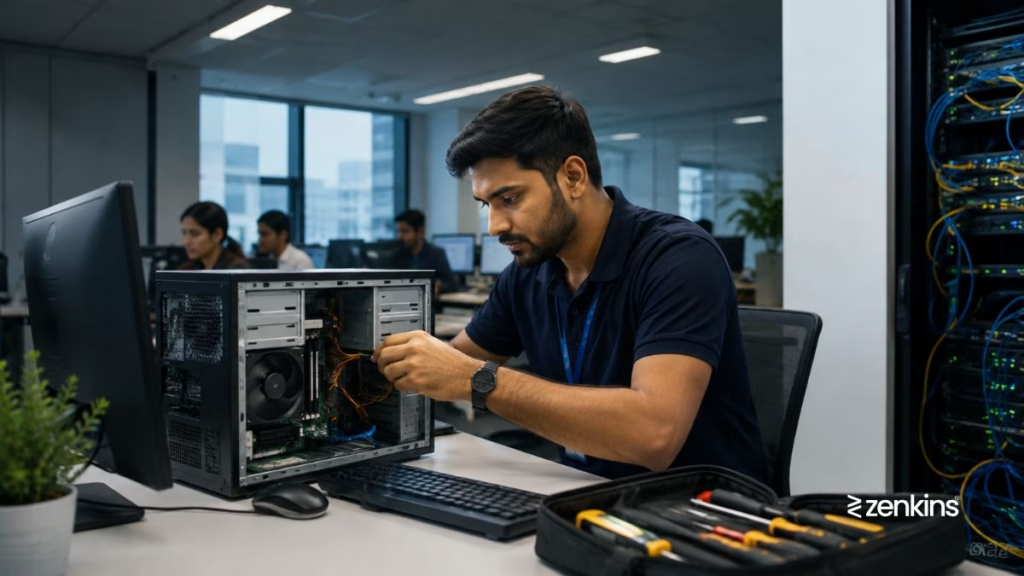
A desktop engineer is an IT professional responsible for installing, configuring, and troubleshooting hardware, software, and network issues for end-users within an organization. They act as the first line of defense when IT problems occur, helping employees and customers resolve technical issues quickly.
Desktop engineers are generally categorized into L1 (Level 1) and L2 (Level 2) support roles. These tiers ensure that issues are resolved at the right level of expertise, minimizing delays and maximizing efficiency.
Understanding L1 vs L2 Desktop Engineers
When you hire desktop engineers L1 vs L2, the core difference lies in the complexity of issues they handle and their technical expertise.

L1 Desktop Engineer (Level 1 Support)
- First point of contact for users.
- Handles basic issues such as password resets, software installations, and minor hardware problems.
- Escalates unresolved issues to L2 support.
L2 Desktop Engineer (Level 2 Support)
- More experienced and technically skilled.
- Handles complex issues beyond L1 capability.
- Works on advanced troubleshooting, root cause analysis, and configuration management.
Roles and Responsibilities of L1 Desktop Engineers
When you hire L1 desktop engineers, they typically focus on basic support tasks. Their key responsibilities include:
- Answering IT support calls, chats, and tickets.
- Performing initial troubleshooting and diagnostics.
- Handling user account setup, password resets, and software installations.
- Assisting with email configuration and printer setup.
- Documenting incidents and updating the knowledge base.
- Escalating unresolved or complex issues to L2 engineers.
👉 Best for: Businesses needing frontline IT support and quick response to common issues.
Roles and Responsibilities of L2 Desktop Engineers
When you hire L2 desktop engineers, you’re bringing in professionals who can handle complex technical problems. Their responsibilities include:
- Advanced troubleshooting of hardware, software, and networking issues.
- Resolving escalated incidents from L1 engineers.
- Conducting root cause analysis to prevent recurring issues.
- Supporting IT infrastructure, operating systems, and enterprise applications.
- Managing system upgrades, configurations, and patches.
- Working with vendors for specialized hardware/software issues.
👉 Best for: Businesses that require deeper IT expertise and long-term problem-solving.
Comparison Table: Hire Desktop Engineers L1 vs L2
Here’s a clear comparison between L1 and L2 desktop engineers:
| Category | Desktop Engineer L1 | Desktop Engineer L2 |
|---|---|---|
| Primary Role | First line of IT support; resolves common user issues | Handles escalated & complex IT problems |
| Typical Tasks | Password resets, printer issues, email setup, basic troubleshooting | Network configuration, OS errors, server connectivity, advanced troubleshooting |
| Technical Expertise | Basic IT knowledge, hardware/software familiarity | In-depth knowledge of networks, servers, security, and system administration |
| Ticket Handling | Manages 70–80% of all tickets | Resolves 20–30% of tickets escalated from L1 |
| Cost | Lower cost per resource | Higher cost due to advanced skill set |
| Best For | Startups, SMEs, and businesses with standard IT needs | Mid-sized to enterprise businesses with complex IT infrastructure |
| Problem Resolution Time | Fast resolution for common issues | Longer, detailed investigation for complex problems |
| Training Needs | Short training, easily onboarded | Requires advanced certifications and domain expertise |
| Work Mode | Often remote-friendly | Often requires onsite presence for escalations |
| Business Value | Reduces downtime for everyday IT issues | Ensures business continuity by solving critical issues |
Business Benefits of Hiring L1 Desktop Engineers
Hiring L1 desktop engineers can provide several advantages to growing businesses:
- Cost Efficiency – L1 engineers handle common IT issues at a lower cost than higher-level engineers.
- Quick Resolution – They address frequent user problems such as login issues or software installation, reducing downtime.
- Improved Productivity – Employees can focus on their work without being stuck on minor IT issues.
- Scalability – As the business grows, L1 engineers can manage increasing ticket volumes.
- Knowledge Base Development – By documenting frequent issues, they create resources for future problem-solving.
Business Benefits of Hiring L2 Desktop Engineers
When you hire L2 desktop engineers, you gain deeper technical expertise and long-term IT stability. Benefits include:
- Advanced Problem Solving – L2 engineers tackle complex issues that L1 cannot resolve.
- Reduced Escalation Time – With in-house L2 support, problems are resolved faster without waiting for external vendors.
- Infrastructure Support – They provide maintenance and configuration of systems, servers, and networks.
- Improved IT Reliability – Root cause analysis prevents recurring problems, enhancing IT resilience.
- Business Continuity – Ensures smooth operations by proactively managing IT risks.
L1 vs L2: Which One Should You Hire?
The choice between L1 vs L2 desktop engineers depends on your business needs:
- For Startups and SMEs → Hiring L1 desktop engineers ensures cost-effective support for daily IT issues.
- For Growing Businesses → A mix of L1 and L2 engineers provides balance—L1 handles ticket volume, while L2 resolves complex problems.
- For Mid-Sized and Enterprise Businesses → A dedicated team of L1 + L2 engineers ensures 24/7 coverage, reduced downtime, and strategic IT management.
Benefits of Hiring Both L1 and L2 Desktop Engineers
Many companies find that hiring both L1 and L2 engineers delivers the best results:
- Efficiency – L1 engineers handle the majority of tickets, while L2 resolves complex cases.
- Cost-Effectiveness – Businesses don’t overspend by assigning simple tasks to L2 engineers.
- Scalability – As demand grows, the structure can easily expand.
- Better SLA Compliance – With proper tiered support, businesses meet service-level agreements.
- Proactive IT Strategy – L2 engineers improve IT systems while L1 maintains day-to-day operations.
Why Businesses Outsource Desktop Engineers to Zenkins
At Zenkins, we provide dedicated desktop engineers (L1 and L2) to meet your unique business needs.
Why Zenkins?
- 24/7 Support Availability – Round-the-clock desktop support.
- Skilled Engineers – Certified L1 and L2 engineers with expertise in multiple IT environments.
- Flexible Models – Hire engineers full-time, part-time, or as a managed service.
- SLA-Driven Services – Guaranteed response and resolution times.
- Tailored for SMBs and Enterprises – From startups to large businesses, we adapt support structures to your size.
Industries That Benefit from L1 & L2 Desktop Engineers
- Finance & Banking – Secure desktop support for sensitive data.
- Healthcare – Ensures compliance and availability of IT systems.
- Retail & E-commerce – Keeps POS, inventory, and online systems running.
- Manufacturing & Logistics – Minimizes downtime in supply chain operations.
- IT & SaaS – Supports internal teams and customer-facing systems.
How to Hire Desktop Engineers (L1 vs L2)
When planning to hire desktop engineers L1 vs L2, follow these steps:
- Assess Business Needs – Identify if you need day-to-day IT support or advanced problem-solving.
- Choose the Right Mix – Hire a combination of L1 and L2 engineers for efficiency.
- Define SLAs – Set clear expectations for resolution times and responsibilities.
- Consider Outsourcing – Partner with companies like Zenkins for flexible, cost-effective hiring.
- Plan for Scalability – Ensure your IT support can grow with your business.
FAQs: Hire Desktop Engineers L1 vs L2
What is the main difference between Desktop Engineers L1 and L2?
L1 Desktop Engineers handle basic troubleshooting, password resets, and first-level user support. L2 Desktop Engineers handle advanced issues such as network troubleshooting, server connectivity, OS errors, and escalations.
Why should businesses care about L1 vs L2 Desktop Engineers?
Understanding the difference helps companies allocate the right resources. Hiring L1 engineers saves costs for routine support, while L2 engineers bring deeper technical expertise for complex IT challenges.
Which is better for a small business: L1 or L2 Desktop Engineer?
For startups and small businesses, hiring an L1 Desktop Engineer is usually enough to manage daily IT issues. However, if your environment includes servers, multiple applications, or advanced IT infrastructure, you should consider adding an L2 Desktop Engineer.
What types of issues can L1 Desktop Engineers resolve?
– Password resets
– Software installation
– Email setup
– Printer & peripheral issues
– Basic troubleshooting of desktops/laptops
What types of issues require an L2 Desktop Engineer?
– Server connectivity problems
– Network configuration issues
– OS & registry-level errors
– Data recovery & patch management
– Advanced security and escalation cases
Is it cost-effective to hire both L1 and L2 Desktop Engineers?
Yes. Many companies adopt a tiered support model where L1 handles the majority of tickets (70–80%), while only 20–30% escalate to L2. This ensures cost savings while maintaining strong technical support.
Can one L2 Desktop Engineer replace multiple L1 Engineers?
Not always. L2 engineers are highly skilled but also more expensive. It’s better to have multiple L1s to handle volume and a few L2s to handle complexity.
Do Zenkins provide both L1 and L2 Desktop Engineers?
Yes. Zenkins offers a flexible hiring model where businesses can hire Desktop Engineers L1 vs L2 based on their exact IT support needs—either individually or as a combined service desk team.
What industries benefit most from hiring Desktop Engineers L1 vs L2?
– Healthcare (critical IT uptime)
– Finance & Banking (secure systems)
– Manufacturing (IT-enabled operations)
– Retail & eCommerce (POS & logistics IT support)
– Startups & SMEs (scalable support models)
How do Desktop Engineers L1 vs L2 improve business productivity?
They reduce downtime, ensure smooth IT operations, and allow employees to focus on core work instead of troubleshooting IT issues—directly boosting efficiency and performance.
Can Desktop Engineers L1 vs L2 work remotely or only onsite?
Both are possible. Many L1 tasks (like software support, email issues) can be handled remotely. But L2 often requires onsite presence for hardware fixes, network troubleshooting, and escalations.
How do I decide whether to hire L1 or L2 engineers first?
If your company faces high ticket volumes with common IT issues, start with L1 engineers. If you already have L1 coverage but face frequent complex escalations, hire L2 engineers.
Conclusion
When it comes to IT support, businesses often debate whether to hire desktop engineers L1 vs L2. The truth is, both play a critical role in keeping IT operations smooth:
- L1 engineers provide cost-effective, first-line support for everyday IT issues.
- L2 engineers offer advanced troubleshooting, root cause analysis, and infrastructure support.
- Together, they create a reliable, scalable, and efficient IT support structure.
For businesses aiming to optimize IT performance while controlling costs, the best approach is to hire both L1 and L2 desktop engineers through a trusted partner like Zenkins.
Zenkins provides skilled engineers, SLA-driven services, and flexible engagement models tailored to startups, SMEs, and enterprises. By outsourcing IT support to Zenkins, you ensure uninterrupted operations and focus on business growth.