Definition
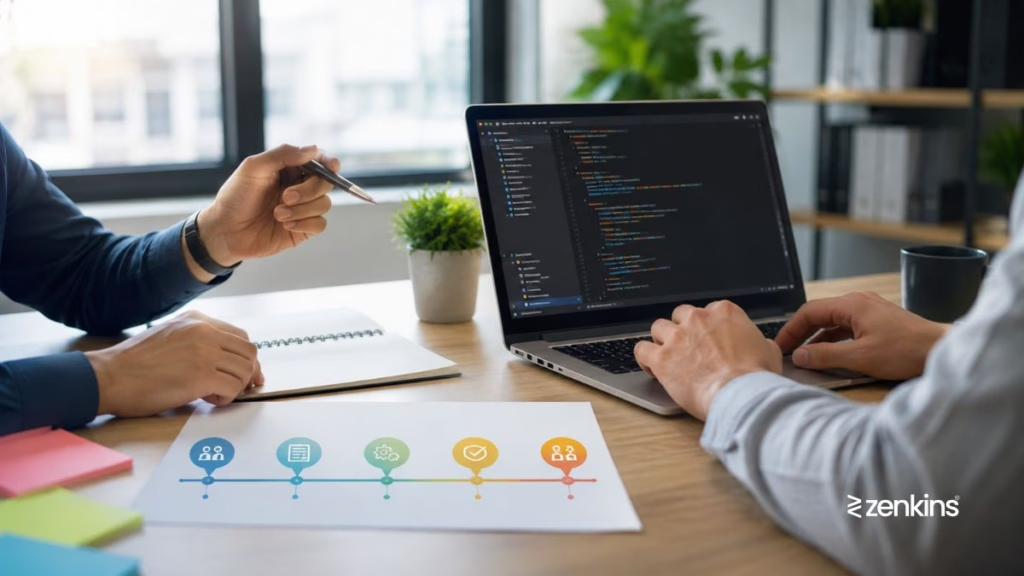
Waterfall software development is a traditional project management methodology where the software development process flows sequentially through predefined stages: requirements, design, implementation, testing, deployment, and maintenance. Unlike iterative methods such as Agile, the Waterfall model follows a strict linear path, meaning each phase must be fully completed before moving on to the next. This approach has been used for decades in industries where structure, predictability, and compliance are paramount.
How Waterfall Software Development Works
The Waterfall model is structured in six major phases:
- Requirements Gathering – All business needs, technical specifications, and functional requirements are documented upfront.
- System & Software Design – Architects and engineers create system designs and architecture diagrams.
- Implementation (Coding) – Developers build the system strictly according to the design documents.
- Testing (Verification) – Quality assurance teams test the entire system once development is complete.
- Deployment – The software is released to the client or into production.
- Maintenance – Post-release updates, bug fixes, and support are handled in this stage.
Because there is no overlapping or iteration between phases, Waterfall emphasizes discipline, planning, and documentation.
Benefits of Waterfall Software Development
Waterfall is not outdated—it is still a reliable approach for certain types of projects. Some of its advantages include:
- Clear Structure – Each phase has defined goals and deliverables, making project tracking easier.
- Extensive Documentation – Comprehensive requirements and design documents help with knowledge transfer and compliance.
- Predictability – Budgets, timelines, and deliverables are easier to estimate upfront.
- Easy to Manage – The sequential process allows managers to control progress stage by stage.
- Suitable for Fixed Requirements – Works best when project requirements are stable and unlikely to change.
Challenges of Waterfall Software Development
While Waterfall offers clarity, it also comes with certain limitations:
- Inflexibility – Changes are difficult to implement once development begins.
- Late Testing – Bugs and issues are discovered only after coding is complete, which can lead to costly fixes.
- Customer Involvement is Minimal – Clients see the final product at the end rather than during development.
- Risk of Misalignment – If initial requirements were misunderstood, the final product may not meet user needs.
- Longer Delivery Times – Entire systems must be built before any usable product is delivered.
Use Cases of Waterfall Software Development
Waterfall is still relevant in certain industries and scenarios:
- Government and Defense Projects – Require strict compliance and documentation.
- Healthcare & Pharmaceuticals – Projects with regulated environments and fixed requirements.
- Banking & Finance – Systems requiring high stability and predictable outcomes.
- Construction & Manufacturing Software – Complex projects where requirements are known upfront.
- Enterprise Systems – Large-scale ERP or CRM solutions with long-term planning cycles.
Why Choose Zenkins for Waterfall Software Development?
At Zenkins, we understand that not every project benefits from Agile or iterative models. For clients with fixed requirements, strict compliance needs, or long-term enterprise systems, our team leverages Waterfall’s structured methodology to deliver reliable results.
Here’s why businesses trust Zenkins for Waterfall projects:
- Strong Documentation & Compliance – We excel at creating clear, detailed requirement and design documents.
- Predictable Delivery – Timelines, budgets, and deliverables are planned upfront with minimal surprises.
- Industry Expertise – Experience in regulated sectors such as healthcare, banking, and government.
- Hybrid Flexibility – We can combine Waterfall’s structure with Agile principles when partial adaptability is needed.
- End-to-End Support – From requirement gathering to long-term maintenance, Zenkins ensures full-cycle success.
Conclusion
Waterfall software development may not be as flexible as Agile, but it remains a proven and structured approach for projects where requirements are stable and compliance is critical. By partnering with Zenkins, businesses can confidently execute Waterfall projects with predictable outcomes, strong documentation, and long-term support.