Definition
Agile software development is a modern, iterative approach to building software that emphasizes collaboration, flexibility, and customer-centricity. Unlike traditional methods that rely on rigid, sequential steps, Agile prioritizes delivering working software in small increments (called iterations or sprints) while continuously adapting to user feedback and changing requirements.
It is based on the Agile Manifesto (2001), which promotes values such as individuals and interactions over processes and tools, customer collaboration over contract negotiation, and responding to change over following a plan.
How Agile Software Development Works
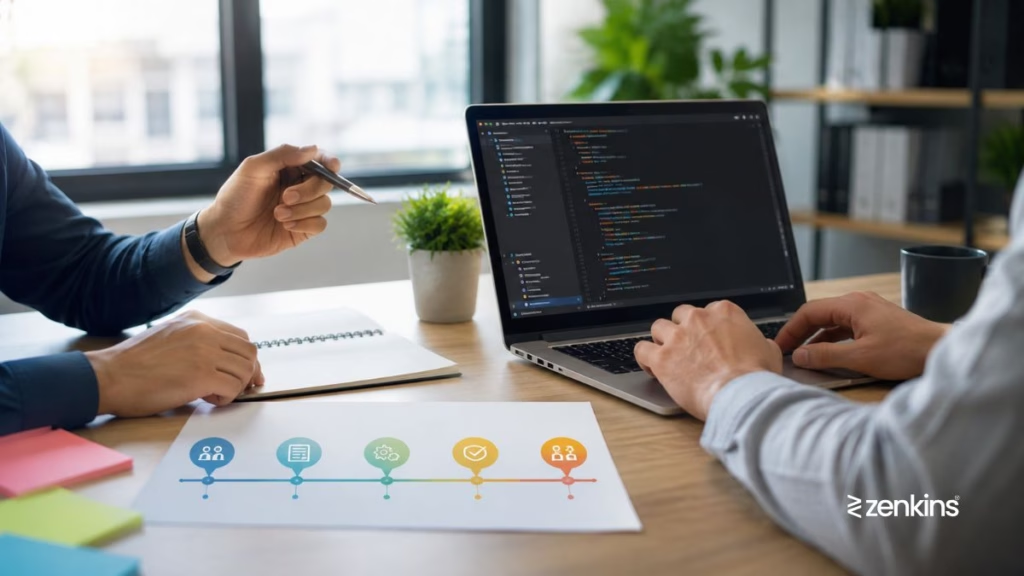
Agile works by breaking projects into short, manageable cycles instead of one long, linear process. Each cycle results in a functional version of the software that can be tested and reviewed. Here’s how the process typically flows:
- Requirement Gathering – Stakeholders and product owners define goals and priorities.
- Sprint Planning – Work is divided into sprints (usually 1–4 weeks long).
- Development – Teams build features incrementally with a focus on working software.
- Testing & QA – Each sprint includes continuous testing to ensure quality.
- Review & Feedback – The client and stakeholders review progress and suggest changes.
- Iteration – Feedback is implemented in the next sprint, and the cycle repeats.
This approach ensures the software evolves in line with real-time needs and user expectations.
Key Features of Agile
- Iterative Delivery – Frequent releases instead of waiting until the project ends.
- Customer Collaboration – Clients are part of the development journey.
- Cross-Functional Teams – Developers, designers, testers, and product owners work together.
- Flexibility & Adaptability – Priorities can change without derailing progress.
- Continuous Improvement – Teams reflect after each sprint to optimize processes.
Advantages of Agile Software Development
- Faster Time-to-Market – Early releases give businesses a competitive advantage.
- Reduced Risks – Issues are detected early before they become costly.
- Higher Quality – Regular testing and feedback loops improve product reliability.
- Better Customer Satisfaction – Users shape the product with ongoing input.
- Improved Team Morale – Empowered teams work collaboratively with ownership.
Challenges of Agile Software Development
While Agile is powerful, it comes with its own set of challenges:
- Client Involvement Needed – Stakeholders must be available for frequent input.
- Scope Creep – Flexibility may lead to uncontrolled changes if not managed well.
- Cultural Shift – Teams used to traditional methods may struggle initially.
- Documentation Trade-Off – Emphasis on working software can sometimes reduce detailed documentation.
When to Choose Agile
Agile works best in scenarios such as:
- Startups – Projects where ideas evolve quickly.
- Product Innovation – When user feedback is critical for shaping the solution.
- Enterprise Projects – Needing continuous improvements or system upgrades.
- Digital Transformation – Where flexibility and adaptability are essential.
For large, fixed-budget, or government projects, Agile may need to be adapted with hybrid models (Agile + Waterfall).
Agile vs. Traditional (Waterfall)
| Aspect | Agile | Waterfall |
|---|---|---|
| Delivery | Iterative (sprints) | Single final release |
| Flexibility | High | Low |
| Risk Management | Early detection | Risk revealed late |
| Customer Involvement | Continuous | Limited |
| Documentation | Minimal, evolving | Heavy upfront |
Agile Methodologies
Agile is not a single framework—it includes multiple methodologies such as:
- Scrum – Sprint-based, team-driven framework with daily stand-ups.
- Kanban – Visual workflow management with focus on continuous delivery.
- Extreme Programming (XP) – Emphasizes coding best practices like pair programming.
- Lean Software Development – Inspired by lean manufacturing, focusing on eliminating waste.
Agile Software Development at Zenkins
At Zenkins, we follow Agile across our services, including:
- Custom Software Development
- SaaS Product Development
- Mobile & Web App Development
- Enterprise Solutions
- Digital Transformation Projects
Our Agile-driven approach ensures:
- Transparency – Clients are part of every sprint cycle.
- Speed – Early releases accelerate time-to-market.
- Scalability – Products evolve seamlessly as business needs grow.
- Quality – Continuous testing ensures stable, secure, and reliable software.
By combining Agile best practices with our domain expertise in industries like finance, healthcare, retail, logistics, and education, we deliver solutions that are both innovative and sustainable.
Conclusion
Agile software development is no longer a trend—it’s the standard for modern IT projects. By embracing iterative development, collaboration, and adaptability, Agile enables businesses to create high-quality, customer-focused products faster.
For startups, SMBs, and enterprises, choosing an Agile-driven partner like Zenkins ensures your projects are not only delivered efficiently but are also future-ready, scalable, and aligned with real business goals.