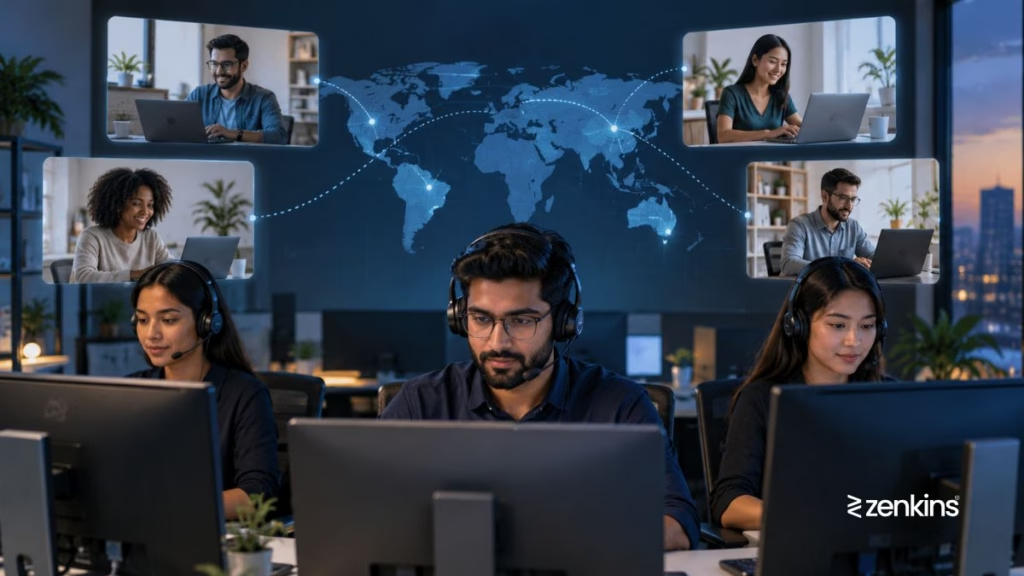
When a server rack goes silent in a Pune manufacturing plant, or a VIP executive’s laptop refuses to boot minutes before a board call in Mumbai, remote troubleshooting only gets you so far. Someone has to physically show up — with the right skills, the right spare parts, and the right sense of urgency. That is the gap on-site IT support in India is built to close, and it is a gap that trips up more global businesses than most IT leaders expect.
Plenty of providers promise “local coverage.” Far fewer can back that promise with the same response-time discipline, escalation matrices, and reporting rigor that a US or European enterprise expects from its own internal IT team. That combination — boots on the ground in Indian cities, held to global-standard SLAs — is exactly what Zenkins has built its on-site support model around.
This article breaks down what on-site IT support actually means in 2026, why it remains essential even in a remote-first world, and how Zenkins structures its local engineering coverage, service tiers, and SLA framework to deliver enterprise-grade reliability across India.
Table of Contents
What Is On-Site IT Support, and Why Does It Still Matter?
On-site IT support refers to technical assistance delivered in person, at the physical location where the issue occurs — a corporate office, data center, retail outlet, warehouse, or manufacturing floor. It sits alongside remote support and help desk services as one of the three pillars of a complete IT support strategy, but it solves a different class of problem.
Remote support and a well-run IT help desk can resolve the vast majority of everyday tickets: password resets, software installs, access issues, minor troubleshooting. But certain problems simply cannot be fixed from a distance:
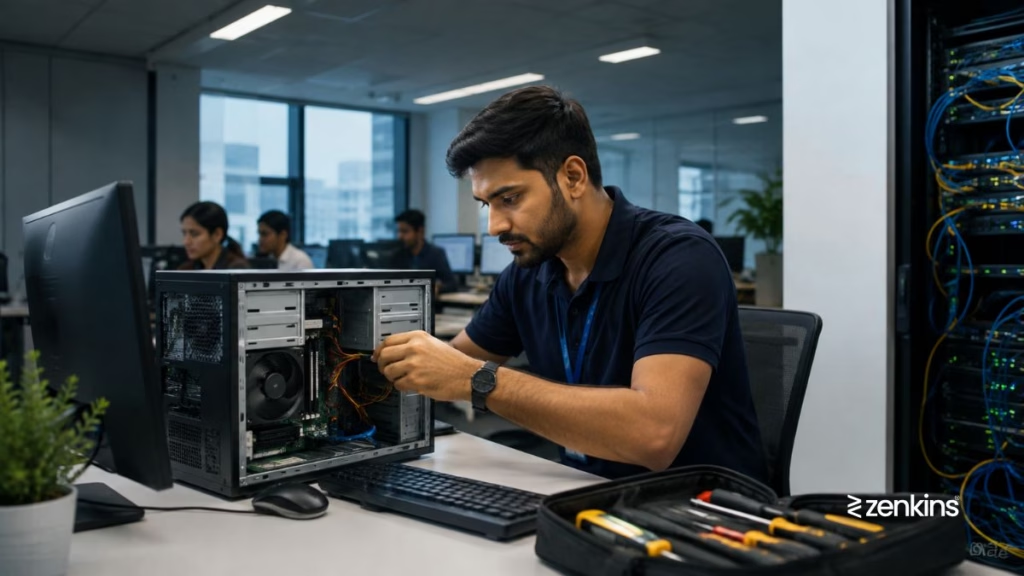
- Hardware failures — a failed hard disk, a dead motherboard, a printer that has physically jammed.
- Network and infrastructure incidents — a switch that has gone offline, a damaged cable run, a Wi-Fi access point that needs repositioning.
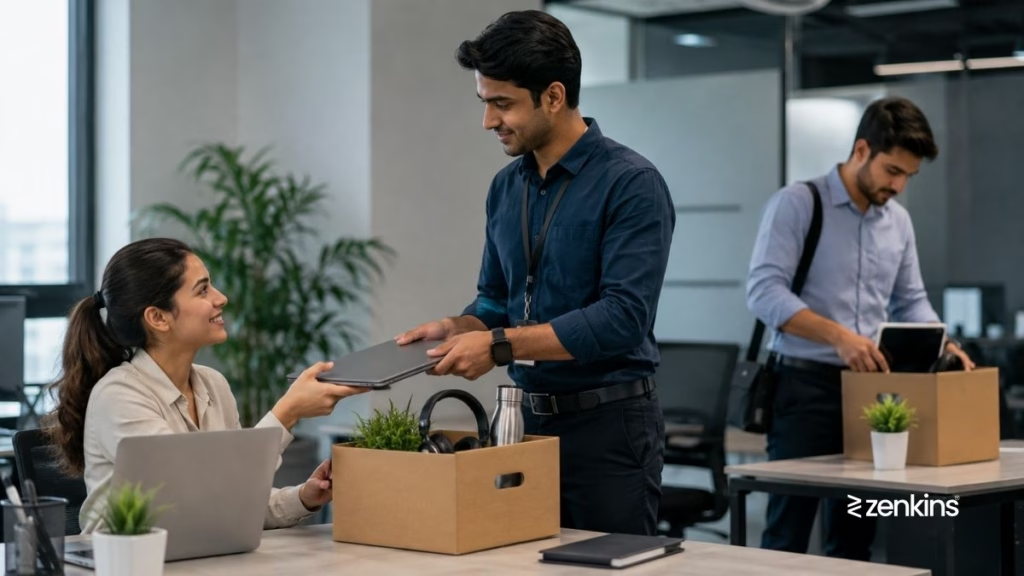
- New employee onboarding — setting up workstations, peripherals, and physical access badges on day one.
- VIP and executive support — leadership expects a technician in the room, not a ticket in a queue.
- Compliance-driven physical audits — asset verification, security walkthroughs, and hardware disposal that regulators require to be witnessed in person.
- Office moves, refreshes, and expansions — cabling, rack builds, and desk setups that only exist in physical space.
For companies that have already outsourced core operations to India — whether through an offshore development center, a managed team, or IT staff augmentation — the absence of dependable local IT coverage is often the one operational risk that gets overlooked until it becomes a crisis.
The Local Coverage Problem: Why Most Providers Fall Short
India is not one market; it is dozens of them stitched together. A vendor that covers Bangalore well may have thin, subcontracted coverage in Vadodara. A provider strong in Delhi NCR may struggle to staff a resident engineer in a tier-2 manufacturing hub. This patchiness creates three recurring pain points for global businesses:
1. Inconsistent technician quality. Many “pan-India” providers rely on a patchwork of local subcontractors for coverage outside their home city. Skill levels, background verification, and professionalism vary wildly from partner to partner — and the client has no direct visibility into any of it.
2. SLA erosion at the edges. A provider might promise a four-hour on-site response nationally, but that number quietly becomes eight or twelve hours once you’re outside their primary metro. Contracts rarely spell out city-by-city SLA differences, so the gap only becomes visible after an incident.
3. Disconnected reporting. When on-site support is subcontracted, ticket data, resolution notes, and asset records often live in different systems than the core help desk. IT managers end up stitching together status updates instead of getting one unified view of every incident, wherever it happened.
Zenkins was built to remove all three of these failure points by owning local delivery directly rather than subcontracting it away.
How Zenkins Structures On-Site IT Support Across India
Direct Local Engineering Teams, Not Subcontractors
Zenkins maintains its own recruited, trained, and background-verified field engineers and resident desktop engineers across Indian business hubs, rather than routing tickets to third-party contractors. This matters for three reasons: consistent hiring standards, a single chain of accountability, and technicians who are genuinely familiar with the client’s environment because they return to the same site repeatedly.
Zenkins currently delivers direct on-site and managed IT services coverage across major Indian business centers, including:
- Managed IT Services in Ahmedabad
- Managed IT Services in Bangalore
- Managed IT Services in Mumbai
- Managed IT Services in Pune
- Managed IT Services in Gandhinagar
- Managed IT Services in Vadodara
Each location is staffed to match local demand — GIFT City and Gandhinagar teams lean into BFSI and fintech compliance needs, Pune and Ahmedabad teams carry deeper manufacturing and automotive floor-support experience, and Mumbai and Bangalore teams are sized for high-density corporate campuses and SaaS headquarters.
Tiered On-Site Support Roles
Not every on-site issue needs the same level of expertise, and staffing every location with senior engineers would be both wasteful and slow. Zenkins structures its field workforce into clear tiers so the right skill level reaches the right ticket:
- Deskside Technicians (L1/L2) handle day-to-day desktop, peripheral, and connectivity issues, employee onboarding/offboarding, and routine hardware swaps. See how Zenkins compares Deskside Technician L2 vs Field Desktop Engineer roles for different ticket volumes.
- Field Desktop Engineers travel across multiple client sites within a city, ideal for businesses with several smaller offices that don’t justify a full-time resident.
- Resident Desktop Engineers are embedded full-time at a single large site — a call-center floor, a manufacturing plant, or a corporate headquarters — for organizations that need a permanent local presence. Zenkins explains the economics of this model in Resident Desktop Engineer: Cost-Effective Onsite IT Support for Enterprises.
- Laptop L2 Technicians specialize in hardware-level repair and diagnostics, reducing dependence on OEM depot turnaround times. The distinctions between this role and general desktop support are covered in Laptop L2 Technician vs Desktop Support Engineer.
- VIP Support Engineers are dedicated to executive floors, where response speed and discretion carry a premium — detailed further in Why Outsourcing a VIP Support Engineer Improves Employee Productivity.
This tiering means a growing SaaS company with three small offices can lean on Field Desktop Engineers, while a 500-seat BPO floor gets a full-time Resident Desktop Engineer who knows the environment inside out.
Where On-Site Meets Remote
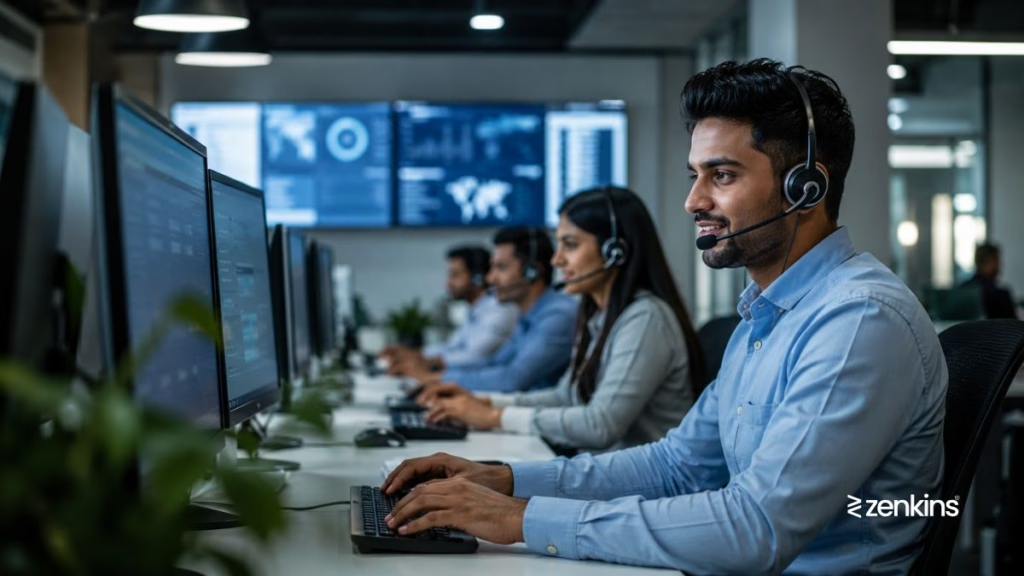
On-site support isn’t a silo — it’s tightly integrated with Zenkins’ broader support stack, including remote IT support, IT service desk services, and managed desktop support. A ticket typically starts at the help desk, gets triaged remotely wherever possible, and only escalates to a field or resident engineer when physical intervention is genuinely required. This triage discipline keeps on-site visits focused on issues that actually need them, which keeps costs predictable and technicians available for true emergencies.
Global-Standard SLAs: What “Global Standard” Actually Means
The phrase “global-standard SLA” gets used loosely in this industry. At Zenkins, it refers to a specific set of commitments modeled on how mature MSPs in the US, UK, and Australia structure their contracts — applied consistently to Indian on-site delivery rather than treated as an offshore afterthought.
Severity-Based Response Tiers
Rather than a single blanket response time, Zenkins classifies incidents by business impact:
| Severity | Example | Typical On-Site Response |
|---|---|---|
| Critical (P1) | Site-wide network outage, server down | Within 1–4 hours, 24/7 for covered sites |
| High (P2) | Department-level outage, VIP device failure | Same business day |
| Medium (P3) | Single workstation hardware fault | Within 1 business day |
| Low (P4) | Non-urgent hardware refresh, peripheral setup | Scheduled visit |
For a deeper look at how these thresholds should be negotiated and what “reasonable” looks like across providers, Zenkins has published a full breakdown in What SLA Response Times Should You Actually Demand from a Managed IT Provider?
ITIL-Aligned Ticket Management
Every on-site engagement is logged, tracked, and closed through the same ITIL-aligned ticketing framework used across Zenkins’ IT service desk and IT help desk operations. That means incident, problem, and change management processes don’t fork into a separate “field ops” system — a CFO or IT director reviewing monthly reports sees on-site and remote resolution data in one consistent view.
Transparent Escalation Paths
Global-standard SLAs are only as good as the escalation matrix behind them. Zenkins publishes clear escalation paths — from the on-site technician, to the shift lead, to the account manager — with defined time triggers at each level, so an unresolved P1 incident never quietly sits in a queue.
Measurable KPIs, Not Just Promises
Contracts include First Response Time, Time to Resolution, First Contact Resolution rate, and Customer Satisfaction (CSAT) as tracked, reportable metrics — not marketing language. This is the same rigor Zenkins applies across its wider Managed IT Infrastructure Services, Network Operations Center (NOC) Support, and Backup & Disaster Recovery offerings.
Industries That Depend on Local, SLA-Backed On-Site Support
BFSI and Fintech. Banks, NBFCs, and fintech firms operating out of hubs like GIFT City cannot tolerate downtime on trading floors or compliance systems. On-site engineers here need both technical depth and an understanding of regulatory audit requirements — a need Zenkins addresses through its BFSI industry practice.
Manufacturing. Plant-floor systems — SCADA terminals, barcode scanners, ruggedized handhelds — fail in ways a remote desk simply cannot fix. Zenkins’ Manufacturing clients typically rely on Resident Desktop Engineers stationed directly on the shop floor.
Healthcare & Life Sciences. Clinical environments need technicians who understand both IT and compliance sensitivity around patient data and device uptime — covered under Zenkins’ Healthcare & Life Sciences practice.
SaaS & Technology. Fast-growing SaaS companies scaling their India offices need on-site support that can flex month to month without a long procurement cycle — a fit addressed by Zenkins’ SaaS & Technology industry offering.
Retail & Ecommerce. Point-of-sale hardware, warehouse scanners, and in-store networks all demand rapid physical response — supported through Zenkins’ Retail & Ecommerce practice.
Cost Considerations: On-Site Support in India vs. In-House Hiring
One reason global businesses turn to a partner like Zenkins instead of hiring in-house is straightforward economics. Recruiting, training, and retaining even a single resident desktop engineer involves payroll overhead, benefits, backup coverage for leave, management time, and equipment — costs that scale awkwardly for a company that only needs one or two on-site headcount in a given city.
Zenkins’ own analysis in IT Infrastructure Setup Cost for 100 Users in India breaks down what a realistic budget looks like for mid-sized deployments, and the Resident Desktop Engineer article compares the fully-loaded cost of an in-house hire against an outsourced resident model. In most cases, businesses find that outsourcing on-site coverage through a managed partner costs meaningfully less than direct hiring, while also removing the burn of unfilled sick days, attrition, and retraining.
For companies weighing this decision more broadly, Zenkins’ guide on How to Reduce IT Support Costs by 50% Using Managed Services in India walks through the mechanics in more detail.
What Sets Zenkins Apart
One provider, one contract, one SLA — nationally. Businesses don’t need to negotiate separate agreements per city or accept vague “best effort” language outside metro hubs.
Engineers who know the account, not a rotating cast. Because Zenkins hires and retains its own field staff rather than subcontracting, the technician who shows up in month six is often the same one who set up the environment in month one.
Reporting that ties on-site activity to the same dashboard as remote support. IT leaders get a single pane of glass across the IT help desk, remote IT support, and field operations — no separate spreadsheet to reconcile.
Scales with the business. Whether a client needs a single Field Desktop Engineer covering two small offices or a team of Resident Desktop Engineers across a 1,000-seat campus, the same SLA discipline and reporting apply.
Backed by full-stack IT capability. On-site support at Zenkins isn’t a bolt-on service — it sits alongside Managed IT Services, Server Management, Network Configuration & Administration, and IT Asset Management — meaning field engineers plug into a mature, well-documented IT environment instead of operating in isolation.
Frequently Asked Questions
What is on-site IT support, and how is it different from remote IT support?
On-site IT support involves a technician physically present at the client’s location to resolve hardware, network, or infrastructure issues that cannot be fixed remotely. Remote support handles software, access, and configuration issues from a distance. Most mature IT strategies use both, escalating from remote to on-site only when necessary.
Which cities does Zenkins provide on-site IT support in?
Zenkins delivers direct on-site coverage across major Indian business hubs including Ahmedabad, Gandhinagar, Vadodara, Pune, Mumbai, and Bangalore, with the ability to extend field coverage to additional locations based on client footprint.
What SLA response times can businesses expect from Zenkins?
Response times are severity-based: critical (P1) incidents typically receive on-site response within 1–4 hours for covered sites, high-priority (P2) issues are addressed same business day, and lower-priority requests are scheduled within one business day or as agreed in the contract.
Is a Resident Desktop Engineer cheaper than hiring in-house?
In most cases, yes. Outsourcing a resident engineer through a managed provider avoids the fully-loaded costs of recruitment, benefits, backup coverage, and attrition that come with direct hiring, while still providing a dedicated, on-site presence.
Can on-site support be combined with remote help desk and managed IT services?
Yes — Zenkins integrates on-site field support with its remote IT support, IT help desk, and managed IT infrastructure services under one SLA and one reporting system, so businesses get a unified support model rather than fragmented vendors.
Does Zenkins support VIP or executive-level on-site IT needs?
through dedicated VIP Support Engineers trained for faster response times, discretion, and familiarity with executive-grade hardware and software environments.
Getting Started with Zenkins’ On-Site IT Support
Local coverage without global SLA discipline is just a directory of technicians. Global SLA language without genuine local presence is just a contract that breaks down the first time something goes wrong outside a major metro. Zenkins was built to deliver both at once — engineers who are genuinely local to Ahmedabad, Pune, Mumbai, Bangalore, Gandhinagar, and Vadodara, held to the same response-time, reporting, and escalation standards a global enterprise would expect from its own internal team.
If your business is evaluating on-site IT support in India — whether to replace inconsistent subcontracted coverage, support a new office opening, or complement an existing offshore or managed team setup — the Zenkins team can walk through coverage options, SLA structures, and pricing for your specific footprint. Contact Zenkins to discuss your on-site IT support requirements, or explore the full range of Managed IT Services available across India.