
Table of Contents
As Indian businesses grow beyond 50 to 100 employees, their IT requirements change dramatically. What worked for a 20-person startup quickly becomes risky, inefficient, and expensive at scale. Password sharing increases, data becomes fragmented, cybersecurity risks rise, and downtime becomes unacceptable.
For founders, CIOs, CFOs, and IT managers, one question becomes urgent:
What is the IT infrastructure setup cost for 100 users in India, and how should we budget for it in 2026?
This guide breaks down the real costs, not just license prices, but architecture, security, implementation, and long-term impact. It explains what you need, why you need it, how much it costs, and how to make smart decisions that protect your business.
This is not a vendor brochure. It is a practical budgeting guide built on real implementations.
Why the 100-User Mark Is a Turning Point
At around 100 users, businesses hit an IT complexity wall.
Before this stage, you may rely on:
- Individual Google or Microsoft accounts
- Local technicians for support
- Basic antivirus
- Flat networks with little segmentation
- Manual onboarding and offboarding
This works until:
- You face your first serious security incident
- A laptop with sensitive data is lost or stolen
- A terminated employee still has access to systems
- You fail a client security audit
- Systems go down during business hours
At this scale, IT becomes a business risk, not just a support function.
This is why structured IT infrastructure becomes mandatory.
The Goal of a Proper IT Setup for 100 Users
A mature IT setup is designed around five principles:
- Identity control. Every user has controlled access.
- Security by default. Endpoints, network, and data are protected.
- Centralized management. Devices and users are managed centrally.
- Scalability. New users and systems can be added easily.
- Resilience. Failures do not become disasters.
The rest of this guide maps costs against these principles.
Cost Breakdown Overview
Below is the high-level structure of the IT infrastructure setup cost for 100 users in India.
| Component | Cost Type | Approx. Investment |
|---|---|---|
| Identity & Software | Recurring Annual | ₹22.0 Lakhs |
| Firewall & Perimeter Security | One-time + Annual | ₹1.8 Lakhs + ₹0.75 Lakhs |
| OS Upgrades | One-time | ₹5.5 Lakhs |
| Professional Services | One-time | ₹2.5 Lakhs |
| Total Year 1 | ~₹31.8 Lakhs + GST |

Now let’s go deeper into each part.
1. The Identity Foundation. Active Directory via Microsoft 365
Why Identity Is the Core
Identity is the foundation of modern IT. Every access decision starts with who the user is.
Traditional Active Directory required expensive on-premise servers and maintenance. In 2026, cloud identity is the default choice.
Recommended Platform
For 100 users, the recommended solution is:
Microsoft 365 Business Premium, which includes:
- Entra ID (cloud identity)
- Office apps
- Intune device management
- Defender for Business security
- 1TB OneDrive storage per user
Cost
- ₹1,830 per user per month
- ₹21.96 Lakhs per year for 100 users
What This Gives You
- Central login for all systems
- Automated onboarding and offboarding
- Conditional access policies
- Device compliance enforcement
- Secure remote work
This single subscription replaces the need for:
- On-premise domain controllers
- Third-party device management
- Separate antivirus subscriptions
- VPN complexity for many use cases
2. Endpoint Security. Your First Line of Defense
Why Antivirus Is Not Enough
Traditional antivirus only detects known malware. Modern attacks use:
- Zero-day exploits
- Fileless malware
- Credential theft
- Ransomware lateral movement
You need EDR. Endpoint Detection and Response.
Cost Scenarios
Included with M365 Business Premium
Defender for Business is included, saving ~₹2.5 Lakhs annually.
Standalone option
If not using M365:
- ₹250 to ₹450 per user per month
- ₹3 Lakhs to ₹5.4 Lakhs per year
3. Network and Perimeter Security
Why Firewalls Matter
Cloud security is essential, but your physical network is still a major attack surface.
You need:
- Intrusion detection
- Web filtering
- VPN security
- Traffic inspection
Cost
- Hardware. ₹1.5 to ₹2.5 Lakhs one-time
- Annual subscription. ₹60,000 to ₹90,000
This protects your office network and remote access.
4. OS Upgrades. The Hidden Cost Nobody Plans For
The Windows Home Problem
Windows Home cannot:
- Join Entra ID or AD
- Support enterprise security policies
- Support centralized management
You must upgrade to Windows Pro.
Cost
- ₹4,500 to ₹5,500 per device
- Up to ₹5.5 Lakhs for 100 systems
This is one of the most common surprise costs.
5. Professional Services. Making It All Work
Technology does not configure itself.
You need experts to:
- Design architecture
- Configure identity
- Set security policies
- Migrate data
- Train users
Cost
- ₹2 Lakhs to ₹3.5 Lakhs one-time
This covers 4 to 6 weeks of implementation.
The Cost of Doing Nothing
Many leaders delay IT investment because it looks expensive.
But the cost of a single serious incident can be far higher.
In 2026:
- Average ransomware recovery costs for SMEs exceed ₹50 Lakhs
- Regulatory fines can reach into crores
- Brand trust damage is long-term
Your ₹31.8 Lakhs investment is not an expense. It is business insurance.
One-Time vs Recurring Costs
| Category | One-time | Recurring |
|---|---|---|
| Firewall | Yes | Subscription |
| OS Upgrade | Yes | No |
| Professional Services | Yes | No |
| M365 Licenses | No | Yes |
| EDR | Maybe | Yes |
This distinction matters for budgeting and approvals.
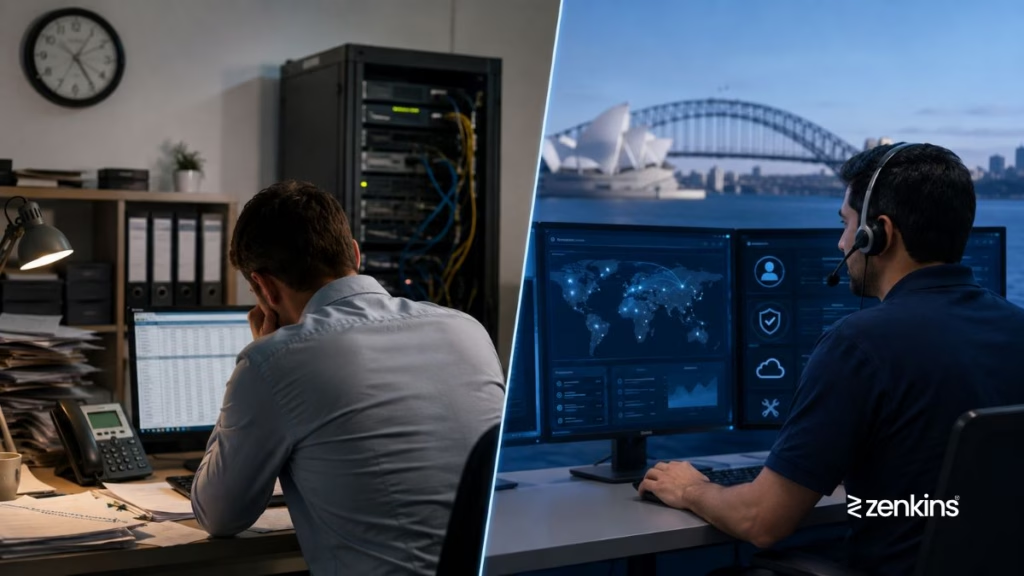
Managed vs In-House Setup
In-House
- Higher HR cost
- Slower response
- Knowledge silos
- Risk of attrition
Managed
- Predictable cost
- 24×7 coverage
- Access to specialists
- Faster resolution
Most 100-user companies choose managed for reliability.
Why Zenkins for This Setup
Designing and deploying secure, scalable IT infrastructure for 100 users is not just a technical exercise. It is an operational and business transformation. The difference between a smooth transition and a painful one lies in experience, process, and execution discipline.
Zenkins is not a reseller or a break-fix vendor. We operate as a long-term IT partner that takes ownership of outcomes, reliability, and security.
Below is why organizations choose Zenkins for IT infrastructure transformation.
1. Proven Experience with 50 to 500 User Environments
We specialize in exactly this growth stage. Companies moving from informal IT to structured enterprise-grade IT.
This stage is complex because:
- You are too large for ad-hoc support.
- You are too small for heavy enterprise bureaucracy.
- You need structure without slowing down.
Zenkins has implemented cloud identity, endpoint security, and network modernization for startups, SMEs, and fast-growing enterprises across India.
We understand:
- The operational realities of Indian businesses
- Budget sensitivity without compromising security
- Regulatory expectations across industries
This means fewer surprises, faster implementation, and better alignment with your business goals.
2. Architecture First. Tools Second.
Many vendors start with tools. We start with architecture.
Before recommending licenses or hardware, we assess:
- Business workflows
- Risk exposure
- Industry compliance
- Growth plans
- User behavior
- Remote and hybrid work models
Only then do we design the identity, security, and network architecture.
This avoids:
- Over-buying licenses
- Over-engineering infrastructure
- Under-protecting critical assets
You get exactly what you need, not what is easy to sell.
3. Security Is Built-In, Not Added Later
Security is not a checkbox at Zenkins. It is embedded in every layer.
We implement:
- Conditional access policies
- Device compliance enforcement
- Least-privilege access models
- Secure remote access
- Regular vulnerability reviews
This reduces breach risk dramatically compared to environments that rely only on antivirus and firewalls.
4. Business-Aligned Implementation, Not Just Technical Deployment
We align implementation with:
- Your business hours
- Critical operations
- Department workflows
- Change management needs
We plan:
- Phased rollouts
- Pilot groups
- Training sessions
- User communication
This ensures adoption without disruption.
5. End-to-End Ownership
Zenkins handles:
- Assessment
- Design
- Procurement guidance
- Implementation
- Migration
- Documentation
- Ongoing management
You do not need to coordinate between vendors, system integrators, and support providers. We act as a single point of accountability.
6. Transparent Cost and ROI Focus
We provide:
- Clear cost breakdowns
- License optimization
- No unnecessary upselling
- Long-term cost forecasting
Our goal is to reduce your total cost of ownership, not increase it.
7. Industry-Specific Experience
We support clients across:
- FinTech and BFSI
- Manufacturing
- Healthcare
- Education
- Professional services
Each industry has different compliance, uptime, and data protection needs. Our solutions reflect those realities.
8. Long-Term Partnership, Not One-Time Projects
We design infrastructure for the next 3 to 5 years, not just for today.
We plan for:
- User growth
- Location expansion
- Cloud migration
- Mergers or acquisitions
- Regulatory changes
This future-ready mindset protects your investment.
9. Dedicated Account Management and Governance
Every Zenkins client gets:
- A dedicated account manager
- Regular service reviews
- Performance reporting
- Improvement recommendations
This keeps IT aligned with business objectives.
10. A Culture of Reliability
Our internal KPIs are focused on:
- Uptime
- Response time
- Security posture
- Customer satisfaction
We are measured by stability, not by ticket volume.
Final Summary: IT Infrastructure Setup Cost for 100 Users in India
Your IT infrastructure setup cost for 100 users in India in 2026 is approximately:
₹31.8 Lakhs + GST in Year 1, followed by primarily recurring license and support costs.
This investment:
- Reduces risk
- Improves productivity
- Enables scale
- Protects your business
Smart IT is not about spending less. It is about spending wisely.
If your business is approaching or crossing 100 users, now is the right time to build a secure, scalable foundation that supports your growth for the next decade.
Zenkins is ready to help you design, implement, and manage it with confidence.