Quick answer: A single in-house Australian IT hire costs an SMB roughly $130,000–$180,000 a year once salary, superannuation, leave, recruitment, and tooling are added up — and that’s for one generalist covering help desk, infrastructure, and security alone. A remote managed IT services engagement typically replaces that same scope for a fixed monthly fee equivalent to a fraction of one local salary, because it draws on a full team rather than one overstretched hire. The gap isn’t marginal. For most Australian SMBs under 150 staff, it’s the difference between a five-figure and a six-figure annual IT line item.
If you’re building an IT budget for 2026, this is the question worth answering properly before you commit to either path: what does IT support actually cost when every line item — visible and hidden — is on the table?
Table of Contents
Why This Question Got Harder in 2026, Not Easier
Three years ago, “hire locally or outsource” was mostly a philosophical debate about control versus cost. In 2026, it’s a math problem with a much less forgiving answer.
Australia’s technology workforce gap has kept widening rather than closing. Industry workforce research from the Australian Computer Society has put the number of unfilled technology roles nationally at around 156,000, with average time-to-hire running past four months for senior positions. Separate modelling on the sector’s longer-term trajectory suggests Australia will need roughly 312,000 additional tech workers by 2030, while local universities produce only around 7,000 IT graduates a year — a supply gap that isn’t closing through domestic hiring alone, regardless of how attractive a role’s salary or benefits package looks.
That scarcity shows up directly in what businesses pay. Recent Australian technical salary data shows senior developer roles that paid around $110,000 in 2020 now commanding $150,000 or more, and specialist tracks have moved even further. Current market bands put mid-level cybersecurity specialists at $120,000–$150,000, with senior security engineers and governance leads reaching $160,000–$210,000+, cloud architects clearing $180,000–$220,000+, and senior DevOps or site reliability engineers at $150,000–$190,000. For a business trying to build even a lean two- or three-person internal IT function, those aren’t outlier numbers — they’re the going rate.
This is precisely the wage-cost pressure that’s pushing Australian SMBs to re-examine remote managed IT as a serious alternative rather than a budget compromise. It’s the same dynamic Zenkins addresses directly on its Managed IT Services in Australia page: a high-wage domestic market combined with a structural talent shortage means the “just hire someone” option is no longer straightforwardly cheaper — or even reliably available.
What In-House IT Actually Costs an Australian SMB in 2026
Most SMB owners budget for IT staff the way they’d budget for any other role: base salary, maybe a rough allowance for super. That’s the visible 60% of the true cost. Here’s the full picture.
1. Base Salary — Already at a Premium
As covered above, Australian technical salaries have moved up sharply, and they vary widely by specialisation:
- Help desk / Level 1–2 support technician: roughly $65,000–$85,000
- Systems administrator: roughly $90,000–$120,000
- Network engineer: roughly $100,000–$140,000
- Cybersecurity specialist: $120,000–$150,000 mid-level; $160,000–$210,000+ senior
- Cloud architect: $180,000–$220,000+
- DevOps / SRE engineer: $120,000–$190,000
Notice the problem immediately: a genuinely capable in-house IT function needs coverage across most of these skill sets — help desk, infrastructure, cloud, and security — not just one generalist. Most SMBs can’t afford to hire five specialists, so they hire one or two people and ask them to stretch across all of it. That stretch is itself a hidden cost, covered below.
2. Superannuation and Statutory On-Costs
Superannuation guarantee contributions add a fixed percentage on top of every salary, and that’s before payroll tax (in states where it applies), workers’ compensation insurance, and leave loading. As a rule of thumb, statutory on-costs typically add 15–20% to base salary before any discretionary benefits are considered.
3. Recruitment Cost and Time-to-Hire
Recruitment agency fees for technical roles in Australia commonly run 15–25% of first-year salary. On a $130,000 hire, that’s $19,500–$32,500 in agency fees alone — and that’s assuming you fill the role quickly. Given the average time-to-hire for senior technical roles is now measured in months rather than weeks, the more expensive cost is often what happens while the seat is empty: tickets pile up, projects stall, and someone less qualified fills the gap on an ad-hoc basis.
4. Training, Certification, and Tooling
Keeping an in-house IT professional current — particularly in cybersecurity, cloud platforms, and compliance frameworks like the ACSC Essential Eight — requires ongoing certification and training spend. Add licensing for monitoring, ticketing, and security tooling that a single hire needs access to but that only makes financial sense at scale, and the tooling line item alone can run into five figures annually for a properly equipped IT function.
5. Management Overhead
An in-house IT hire needs a manager, performance reviews, HR support, and someone to make decisions when they’re on leave, sick, or have resigned. For SMBs without an existing IT leadership layer, this overhead usually falls on a founder, ops lead, or finance manager — time that has its own opportunity cost, even if it doesn’t show up as a line item on the P&L.
6. Turnover and Single-Point-of-Failure Risk
This is the cost most SMBs underweight until it happens to them. When your IT knowledge lives in one or two people’s heads, their resignation isn’t just a recruitment cost — it’s an operational risk. Undocumented systems, password vaults only one person can access, and vendor relationships tied to a single point of contact all become liabilities the moment that person leaves. Rehiring and re-onboarding into that gap typically takes months, during which the business runs on thinner support than it budgeted for.
Adding it up: a single mid-level in-house IT hire in Australia realistically costs an SMB somewhere between $130,000 and $180,000 in true annual cost once salary, on-costs, recruitment amortisation, tooling, and management time are included — and that’s for one person covering a scope that a properly resourced team would split across several specialists. Related reading: Why SMBs Pay More for IT Than Enterprises Without Realizing It breaks down why this cost structure disproportionately punishes smaller businesses.
What Remote Managed IT Actually Costs
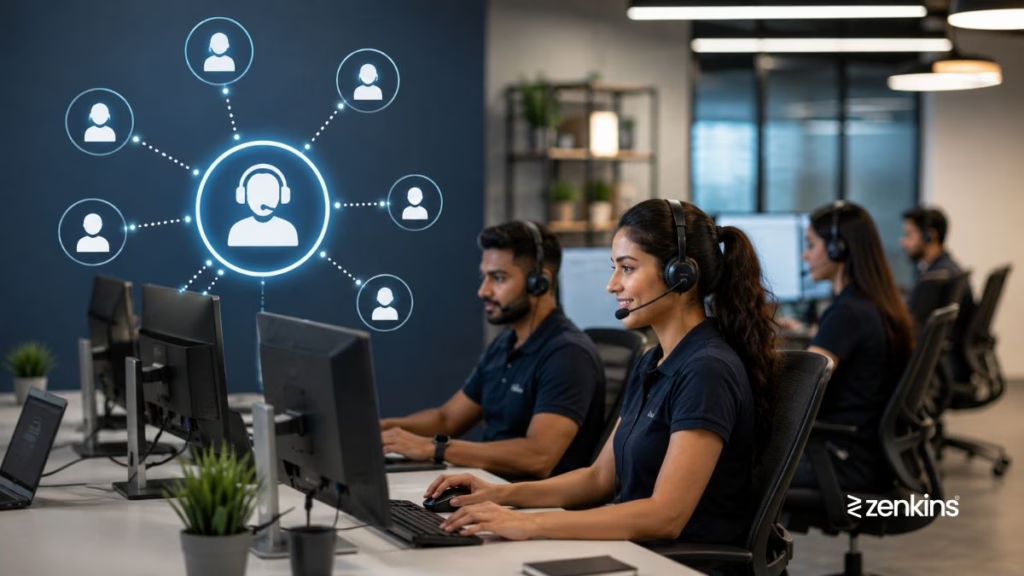
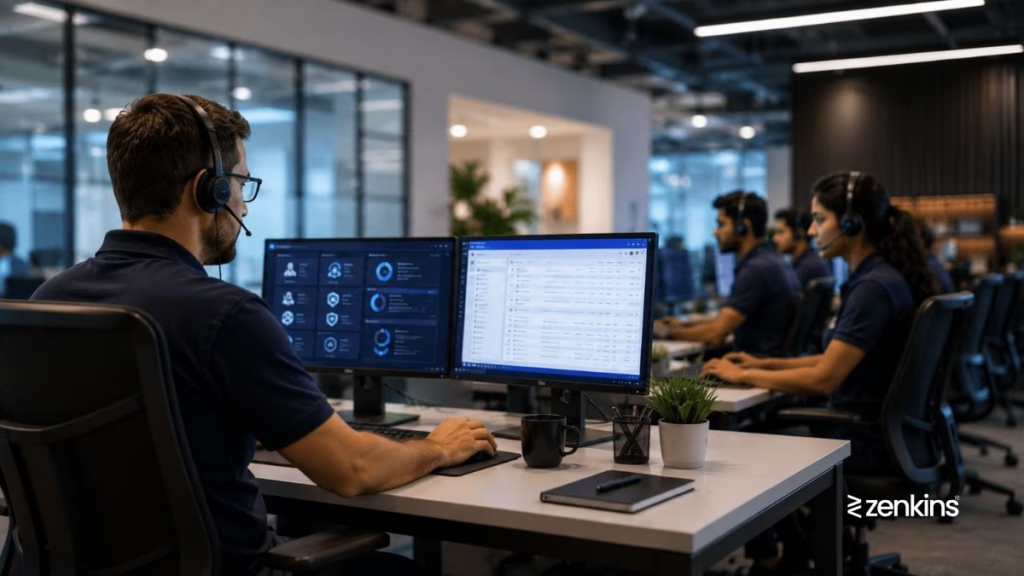
A remote managed IT services (MSP) model works differently in structure, not just price. Instead of paying for headcount, you pay a fixed monthly fee for a defined scope of coverage — help desk, infrastructure management, cloud administration, and security operations — delivered by a team, not an individual.
The Fixed-Fee Model
Pricing is typically structured per user, per device, or per service tier, and scoped against defined SLAs — response times, escalation paths, and coverage hours are contractual, not aspirational. That predictability is one of the biggest practical differences from in-house IT: your IT line item doesn’t move because someone resigned, took extended leave, or needed six weeks of onboarding.
What’s Actually Included
A well-structured remote MSP engagement typically bundles coverage that would otherwise require multiple in-house specialists:
- L1, L2, and L3 help desk and service desk support — the same tiered structure a larger internal team would provide, without needing to hire separately for each tier
- Infrastructure and server management across on-premises, hybrid, and cloud environments
- Cloud and SaaS operations — Microsoft 365, Google Workspace, and line-of-business application administration
- Security operations aligned to a recognised framework (in Australia, typically the ACSC Essential Eight — patching discipline, MFA, admin privilege restriction, application control, and backups)
- Network monitoring and administration
- Backup and disaster recovery management
That’s the scope a full internal function — help desk technician, sysadmin, and a part-time security focus — would otherwise need to cover separately, at separate salaries.
The Time Zone Advantage That Changes the Delivery Math
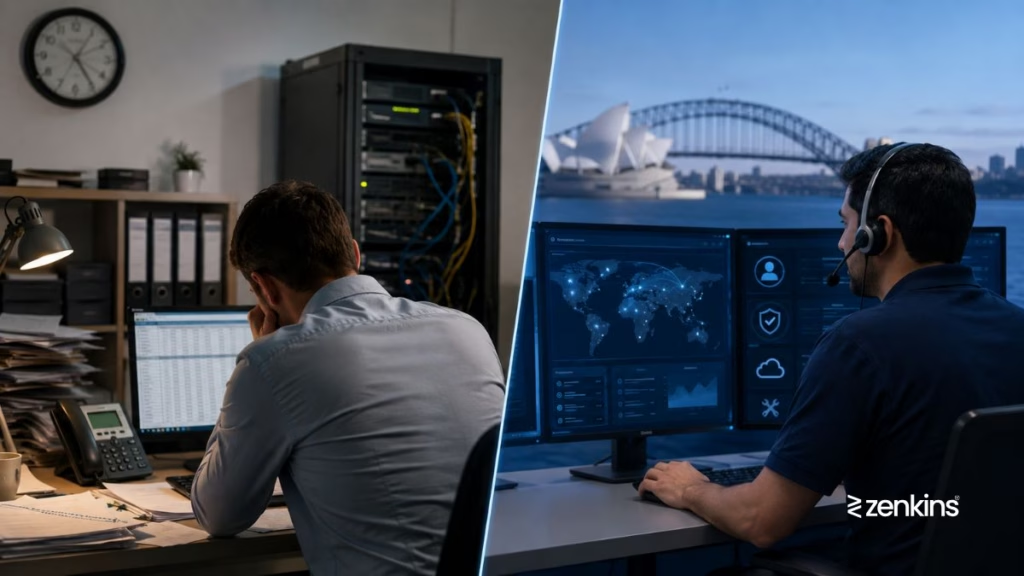
For Australian SMBs specifically, remote delivery from India carries a structural advantage that doesn’t exist for most other outsourcing corridors: the time zone overlap. India Standard Time sits roughly 4.5–5.5 hours behind AEST/AEDT, which means a remote team starting its day in the Indian morning is already active by early-to-mid afternoon in Sydney, Melbourne, and Brisbane — and can keep working well into the Australian evening. That’s coverage most local providers and in-house teams don’t offer at SMB pricing, because it would mean paying a local employee an after-hours premium. Zenkins’ Managed IT Services in Australia model is built specifically around this overlap, turning what could be a delivery constraint into extended, real-time coverage.
What’s Genuinely Not Included
Fixed-fee MSP pricing isn’t unlimited-everything. Most engagements scope out major infrastructure projects (a data centre migration, a full network redesign), onsite hardware work if the provider is fully remote, and highly specialised, one-off consulting. Zenkins is explicit about this on its Australia service page: it doesn’t currently provide onsite visits or a physical engineer in Australia — everything is delivered remotely, which is precisely what keeps the pricing structure below a local-hire or local-vendor cost base. If your business genuinely needs a person walking the floor fixing printers, that’s a different service model, and any MSP that claims to do both cheaply is worth questioning.
Side-by-Side: What Changes When You Switch Models
Rather than a single number, it’s more useful to think about what actually shifts when an SMB moves from in-house to remote managed IT.
Cost structure: In-house IT is a fixed headcount cost that scales in discrete, expensive jumps — you can’t hire half a security specialist. Remote managed IT scales more smoothly with user count and service tier, and the fee doesn’t change because someone resigned.
Coverage depth: One or two in-house generalists cover what they can, and gaps in their skill set become the business’s blind spots. A managed IT provider draws on a full bench of specialists — the security-literate resource isn’t the same person handling password resets.
Coverage hours: In-house support typically covers local business hours only, unless the business pays an on-call premium. A remote MSP built around the AEST/IST time zone gap can extend meaningfully into the Australian evening without extra cost.
Continuity risk: In-house IT concentrates institutional knowledge in one or two people. A managed provider spreads that knowledge across a team and documents it as standard practice, reducing single-point-of-failure risk.
Response predictability: In-house response time depends on whether the one IT person is already handling something else. Managed IT response times are contractual SLAs — see What SLA Response Times Should You Actually Demand from a Managed IT Provider? for what “good” looks like in a contract.
Security maturity: Building structured security practices — patch management cadences, MFA enforcement, tested backups — takes deliberate investment that’s easy to deprioritise when one generalist is also fielding help desk tickets. A managed provider treats it as core scope, not an add-on project.
The Hidden Costs Both Sides Don’t Advertise
To be fair to both models, neither is free of trade-offs.
In-house IT’s hidden costs are mostly about fragility: the cost of downtime while a key person is unreachable, the cost of a security gap nobody had time to close, and the cost of institutional knowledge walking out the door with a resignation. None of these show up in a salary line, but they show up in outcomes.
Remote managed IT’s hidden costs, when they exist, usually come from choosing the wrong provider rather than the model itself: vague SLAs that sound reassuring but aren’t measurable, providers who oversell 24/7 coverage without the staffing to back it, or engagements scoped so tightly that “extra” requests turn into unexpected add-on fees. The way to avoid this isn’t to avoid the model — it’s to scrutinise the contract. What Is a Managed IT Service Provider (MSP)? Everything Your Business Needs to Know covers what a properly structured engagement should include before you sign.
When In-House IT Still Makes Sense
Remote managed IT isn’t the right answer for every Australian SMB, and it’s worth being honest about where in-house still wins:
- Highly regulated environments requiring an onsite physical presence — certain defence, critical infrastructure, or government-adjacent contracts mandate on-premises personnel with security clearances.
- Businesses with heavy, constant hands-on hardware needs — manufacturing floors or labs with specialised, physically fragile equipment that needs a person present daily.
- Organisations large enough to justify a full specialist bench in-house — once headcount and budget support multiple dedicated specialists (security, cloud, infrastructure) without stretching anyone thin, the economics shift.
For most SMBs under roughly 150 employees, though, none of these conditions typically apply, which is why the shift toward remote managed IT has accelerated rather than plateaued through 2025 and into 2026.
It’s also worth noting that this isn’t strictly binary. Many Australian SMBs land on a co-managed model — keeping one internal person for local context, strategic decisions, and vendor relationships, while a remote provider handles defined operational functions like help desk, patching, and security monitoring. This hybrid approach often gives businesses the best of both: someone in the building who understands the specific quirks of the business, backed by a full remote team that provides depth and after-hours coverage a single internal hire never could on their own.
What Switching Actually Involves
One reason SMBs delay this decision longer than they should is uncertainty about the transition itself — will there be a support gap, will existing systems need to be rebuilt, will staff notice the change. In a properly run engagement, none of that should happen.
Discovery and scoping. A competent provider starts by mapping your current environment — user count, applications, existing vendor relationships, and any sector-specific compliance obligations — before proposing pricing or a service tier. If a provider quotes a fixed fee without this step, treat that as a red flag rather than efficiency.
Access provisioning and documentation. This is where a lot of the “hidden cost” of in-house IT gets surfaced and fixed: undocumented passwords, single-person admin access, and systems nobody wrote down get properly documented as part of onboarding, which is itself a risk-reduction exercise independent of the cost savings.
Parallel running, not a hard cutover. Most transitions run a short overlap period where the new provider is actively monitoring and responding while any existing arrangement winds down, so there’s no coverage gap in between.
Typical timeline. For a well-documented environment, onboarding a remote managed IT provider usually takes one to three weeks. Poorly documented environments — often a symptom of the exact single-point-of-failure risk described earlier — can take longer, which is itself a data point about how much risk the business was carrying beforehand.
How to Calculate Your Own Break-Even
Rather than relying on averages, run the numbers for your specific business:
- List every role your IT function needs to cover — help desk, infrastructure, cloud, security — not just the roles you can currently afford to hire.
- Price each role at current Australian market rates, not what you paid two years ago (see the salary bands above).
- Add 30–40% on top of base salary for super, on-costs, recruitment amortisation, and tooling.
- Multiply by headcount needed for full coverage, not just the one generalist you’re planning to hire.
- Compare that total against a quoted fixed monthly fee from a managed IT provider scoped to the same coverage.
In almost every case, the in-house total for genuinely complete coverage — not a single overstretched hire — comes out well above the managed IT fee, particularly once turnover risk and coverage-hour limitations are priced in. For a deeper look at how MSP pricing is typically structured, see Managed IT Services Pricing: What’s the Real Cost in 2025?
Why Australian SMBs Are Making the Switch in 2026
The pattern showing up across Australian SMBs this year isn’t a one-off cost-cutting decision — it’s a response to structural conditions that aren’t reversing. The tech talent shortage isn’t easing, wage growth in technical roles is outpacing general wage growth by a wide margin, and cyber insurance and compliance expectations (Essential Eight alignment, Privacy Act obligations) are rising regardless of business size. Layer on Australia’s geography — businesses with staff spread from Perth to Brisbane often need centralised support rather than a patchwork of regional arrangements — and remote managed IT stops being a fallback option and starts being the more rational default.
Zenkins built its Managed IT Services in Australia offering specifically around these conditions: extended AEST/AEDT coverage through the IST time zone overlap, Essential Eight-aligned security operations, and fixed monthly pricing that reflects offshore delivery economics rather than local salary benchmarks — without requiring an onsite engineer.
Frequently Asked Questions
Is remote managed IT cheaper than hiring an in-house IT person in Australia?
In almost all cases, yes, once the full cost of an in-house hire is counted — base salary, superannuation, recruitment fees, tooling, training, and management overhead. A single in-house generalist also can’t match the specialist coverage (security, cloud, infrastructure) a managed IT team provides for a comparable or lower fixed monthly cost.
How much does an in-house IT hire really cost an Australian SMB in 2026?
Realistically $130,000–$180,000 in true annual cost for one mid-level generalist, once superannuation, on-costs, recruitment fees, and tooling are included — and that’s before accounting for the coverage gaps a single hire inevitably has.
Can a remote MSP actually provide the same support quality as a local IT team?
Yes, when the provider builds SLAs, response times, and escalation paths into the contract rather than leaving them informal. For Australia specifically, the India–Australia time zone overlap means remote teams can be actively working during — and beyond — Australian business hours, which many local single-person IT setups can’t match.
What’s the biggest hidden cost of in-house IT that SMBs underestimate?
Turnover risk. When IT knowledge lives with one or two people, their resignation creates an operational gap that can take months to properly refill, during which the business runs on reduced coverage.
Does managed IT include cybersecurity, or is that a separate cost?
It depends on the provider’s scope, but a well-structured managed IT engagement should include baseline security operations — patching, MFA enforcement, admin privilege restriction, and backup management — as standard, not an upsell. Ask specifically whether the provider aligns to a recognised framework like the ACSC Essential Eight.
Is a fully remote IT provider secure enough for an Australian business with no local engineer?
Yes, provided access management, monitoring, and security controls are built properly — remote delivery and security maturity are separate questions. The relevant test is whether the provider can show structured practices against a framework like Essential Eight, not whether someone is physically in the building.
The Bottom Line
The wage-cost argument for remote managed IT isn’t a sales pitch — it’s arithmetic that gets more compelling every year the Australian tech talent shortage persists. A single in-house hire, fully costed, now runs well into six figures for coverage that’s still narrower than a managed team provides for less. For most Australian SMBs planning 2026 budgets, the question isn’t really “in-house or outsourced” anymore — it’s whether your current model is quietly costing you more than you’ve measured.