If you are trying to reduce IT support costs for your SMB in 2026, you have likely faced the same question: should we invest in an AI chatbot for IT support, or outsource to a managed IT help desk provider? Both promise cost savings. Both sound like the smarter alternative to hiring in-house. But they serve fundamentally different needs — and choosing the wrong one will cost you more in the long run.
This post breaks down the real difference between managed IT help desk services and AI chatbots, examines what each actually delivers for SMBs, and gives you a clear framework for deciding which approach — or which combination — makes sense for your business in 2026.
Bottom line up front: For most SMBs, the question isn’t ‘managed IT help desk vs. AI chatbot’ — it’s understanding which problems each one actually solves.
Why SMBs Are Rethinking IT Support Costs in 2026
Small and medium-sized businesses face a structural IT support challenge. They need reliable, fast, and skilled IT support — but they cannot justify the salary cost of a full in-house IT team. At the same time, IT downtime is increasingly expensive: a recent industry survey found that IT-related disruptions cost SMBs between $10,000 and $50,000 per hour depending on the sector.
Two solutions have emerged as the dominant alternatives to in-house IT teams:
- AI chatbots for IT support: Low-cost automated tools that handle common IT queries through conversational interfaces, typically integrated into Slack, Microsoft Teams, or a self-service portal.
- Outsourced managed IT help desk: A dedicated team of IT engineers — often based in India — who handle tickets, incidents, and IT operations on behalf of your business, often at a fraction of onshore labor costs.
Both can reduce IT support costs for SMBs. But they do so in different ways and with different ceilings on what they can handle. Understanding these differences is the key to making the right investment.
What AI Chatbots for IT Support Actually Do
AI chatbot IT support tools — deployed through platforms like Freshservice, Intercom, or custom GPT-based integrations — are designed to deflect tickets before they reach a human agent. They handle:
- Frequently asked questions about IT policies, software access, and VPN setup
- Guided troubleshooting for common issues (Wi-Fi, email, printer connectivity)
- Password reset workflows (when integrated with identity providers like Okta or Azure AD)
- Ticket creation and categorization for issues that need human follow-up
- Status updates on ongoing incidents or change requests
Where AI Chatbots Excel
AI chatbots are genuinely effective at ticket deflection. Businesses with high volumes of repetitive, self-service-appropriate queries can reduce inbound ticket load by 20–40% using a well-configured chatbot. They are available 24/7, cost very little to run at scale, and improve measurably as they process more conversations.
Where AI Chatbots Fall Short
The ceiling on AI chatbot IT support is well-defined and often reached quickly. Chatbots struggle with:
- Novel or complex issues: Any problem the chatbot hasn’t been trained on results in a dead end or incorrect guidance — frustrating users and eroding trust.
- Multi-system troubleshooting: Issues that require checking multiple systems (network, endpoint, application, cloud) exceed what most chatbots can investigate.
- Active resolution: Most chatbots guide users through steps rather than executing fixes. They cannot reset passwords in Active Directory, push software patches, or reconfigure network settings.
- Escalation quality: When chatbots escalate to a human, they often do so with minimal context — increasing resolution time rather than reducing it.
What Managed IT Help Desk Services Actually Do
An outsourced managed IT help desk provides human IT engineers — typically operating from India-based delivery centers — who manage your end-user IT support operations. This includes:
- Tier-1, Tier-2, and Tier-3 ticket resolution across hardware, software, network, and cloud
- Proactive monitoring of your IT infrastructure and endpoints
- Incident management, change management, and problem management per ITIL frameworks
- SLA-driven response and resolution targets with reporting and accountability
- Integration with your existing ITSM tools and communication platforms
- After-hours and 24/7 coverage with no overtime premiums
Where Managed IT Help Desk Excels
The fundamental advantage of managed IT help desk is that it replaces or extends a full IT function — not just a self-service layer. Human engineers can troubleshoot anything. They can diagnose, execute, escalate intelligently, document properly, and improve your IT environment over time. For SMBs that have eliminated or reduced their internal IT team, a managed help desk is the operational backbone of their entire IT capability.
Where Managed IT Help Desk Costs More
The honest limitation of managed IT help desk is unit economics at very low ticket volumes. If your SMB generates only 20–30 tickets per month — all of which are simple self-service queries — the monthly retainer for a dedicated managed help desk team may exceed the value delivered by pure ticket handling. In those cases, a hybrid model is often optimal.
Head-to-Head Comparison: Managed IT Help Desk vs. AI Chatbot
| Criteria | AI Chatbot | Managed IT Help Desk |
| Monthly cost (SMB) | Low — $50–$500/mo SaaS fee | Medium — $800–$4,000/mo depending on coverage |
| Ticket resolution scope | Simple, FAQ-style queries only | Full Tier 1–3 resolution |
| Active fix execution | Rarely — guides users only | Yes — executes fixes directly |
| Complex troubleshooting | Not capable | Core capability |
| After-hours coverage | 24/7 automated responses | 24/7 with live engineers (India-based) |
| Infrastructure monitoring | None | Included in most managed plans |
| ITSM tool integration | Limited read access | Full read-write integration |
| Compliance & audit trail | Basic logging only | Full ITIL-compliant documentation |
| Scalability | Scales to unlimited volume | Scales with team sizing |
| Setup time | Days to weeks | Weeks to a month |
The Real Cost Calculation for SMBs
When SMBs evaluate how to reduce IT support costs, they often look at the monthly subscription fee for an AI chatbot versus the retainer for a managed IT help desk — and conclude that the chatbot is cheaper. This comparison is incomplete.
The true cost of IT support includes:
- Direct support cost: What you pay for the service (chatbot subscription or managed help desk retainer).
- Unresolved ticket cost: Every ticket the chatbot cannot resolve becomes either an employee productivity loss (if the user waits) or a demand on an internal IT person who could be doing higher-value work.
- Downtime cost: When a chatbot reaches its ceiling on a serious incident — network outage, ransomware, server failure — the gap until human resolution begins is pure business cost. Managed IT help desk teams respond to P1 incidents immediately.
- Internal overhead cost: If your AI chatbot still requires someone to manage escalations, train the model, handle edge cases, and communicate with end users about unresolved issues, that internal time has a cost that rarely appears in the chatbot’s price tag.
A common SMB mistake: deploying a $200/month AI chatbot and then having a $90,000/year internal IT person spend 30% of their time handling chatbot failures. The actual cost of IT support in that scenario is over $30,000/year — not $2,400.
The Hybrid Model: What Most Growing SMBs Actually Need
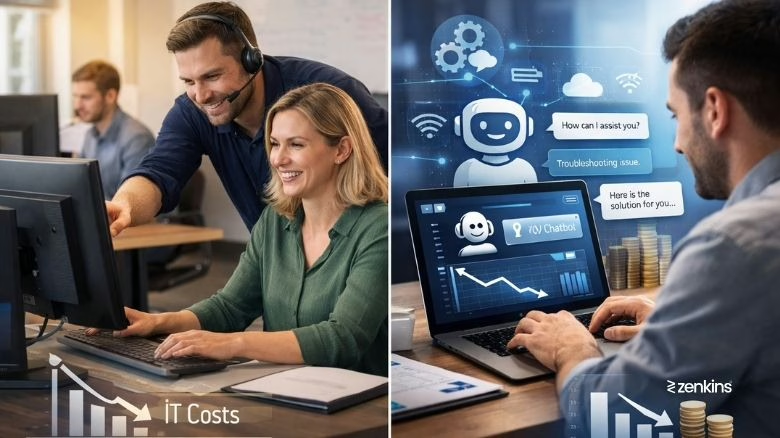
The most cost-effective IT support model for most SMBs in 2026 is a hybrid: an AI chatbot layer handling self-service ticket deflection, backed by a managed IT help desk team that resolves everything the chatbot cannot.
This is precisely how modern managed IT help desk providers — including Zenkins — structure their service delivery. The AI layer deflects 30–50% of incoming tickets automatically. The remaining tickets go to human engineers who resolve them with speed, context, and ITSM discipline.
The result: you get the cost efficiency of AI automation without sacrificing the reliability of human expertise on issues that matter.
What This Looks Like in Practice
- Employee submits a ticket: AI agent classifies it and checks if it can resolve autonomously.
- Self-service or guided resolution: For common Tier-1 issues, the AI handles it in minutes, no human involvement.
- Human escalation with context: For anything complex, a Tier-2 engineer at Zenkins receives the full ticket history, attempted resolutions, and system diagnostics — and picks up from there.
- SLA tracking and reporting: Every ticket, automated or human-handled, is tracked against your SLAs with full reporting visibility.
When to Choose an AI Chatbot (And When Not To)
Choose an AI chatbot if:
- Your IT support needs are genuinely limited to FAQ-style self-service queries
- You already have a functioning IT team and want to reduce their Tier-1 volume
- Your ticket volume is very low and a managed help desk retainer would be disproportionate
- You are in a low-complexity IT environment with limited infrastructure dependencies
Choose managed IT help desk outsourcing if:
- You need reliable resolution — not just guidance — for IT issues
- You have reduced or eliminated your internal IT function
- You need after-hours coverage without building a shift-based internal team
- Your IT environment is complex: cloud infrastructure, multi-site, ERP/CRM integrations
- You need SLA accountability, compliance documentation, and proactive monitoring
- You are scaling rapidly and need IT support that grows with headcount
How Zenkins Helps SMBs Reduce IT Support Costs
Zenkins provides managed IT help desk support for SMBs and mid-market companies from our India-based delivery centers. Our model is designed specifically for businesses that need reliable, cost-effective IT support without the overhead of building an internal team.
Our managed IT help desk services for SMBs include:
- Dedicated or shared IT help desk engineers — you choose the coverage model
- AI-assisted ticket classification and Tier-1 automation built into our delivery workflow
- Integration with your ITSM platform: Zendesk, Freshdesk, ServiceNow, Jira, Zoho Desk
- After-hours and 24/7 coverage with no shift premium costs
- Monthly reporting on ticket volume, resolution rates, SLA compliance, and cost per ticket
- Flexible scaling — add or remove engineers as your headcount and needs evolve
Clients who outsource their IT help desk to Zenkins typically reduce their all-in IT support cost by 40–60% compared to maintaining an equivalent in-house team in the US, UK, or Australia — while improving resolution time and after-hours availability simultaneously.
Conclusion: Pick the Right Tool for the Right Problem
The choice between a managed IT help desk and an AI chatbot is not about which technology is more impressive. It is about matching the solution to the actual scope of your IT support needs.
AI chatbots reduce IT costs by deflecting simple, self-service queries at scale. Managed IT help desk services reduce IT costs by replacing expensive in-house teams with efficient, offshore-delivered expertise. The best outcome for most SMBs combines both — with the right managed IT partner providing the AI infrastructure alongside the human engineering capability.
Zenkins offers a free IT support assessment for SMBs. We analyze your current ticket volume, issue types, and support costs — and recommend the right coverage model to reduce your IT support costs in 2026.