Agentic IT support is no longer a futuristic concept. In 2026, it is the defining shift in how modern enterprises handle Tier-1 IT help desk operations — and businesses that adopt it early are already reporting dramatic improvements in resolution time, ticket volume, and operational cost.
This guide explains what agentic IT support means, how AI agents work within a managed IT help desk environment, why they are increasingly replacing human Tier-1 agents, and what that means for your business — whether you run a lean SMB or a large enterprise with distributed teams.
Key insight: AI agents in IT support don’t just answer questions — they take autonomous action. That’s what separates agentic AI from the chatbots of yesterday.
Table of Contents
What Is Agentic IT Support?
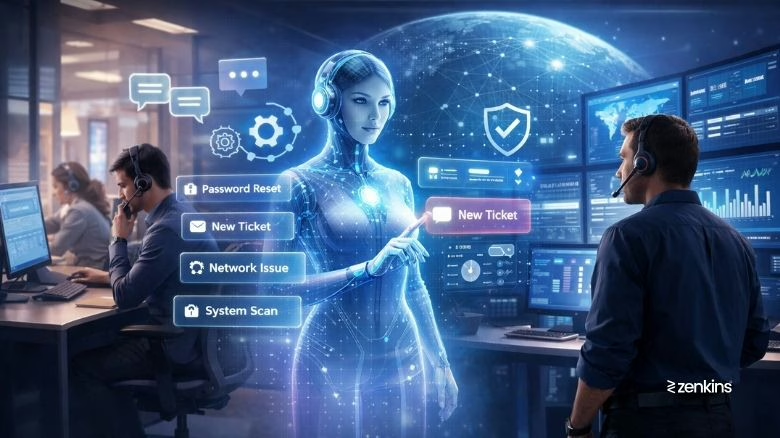
Agentic IT support refers to the use of autonomous AI agents that can perceive, reason, and act within IT environments — without waiting for human instruction at each step. Unlike traditional helpdesk automation that follows a fixed decision tree, agentic AI systems can handle multi-step tasks, integrate with your ITSM tools, reset credentials, diagnose network issues, trigger workflows, and escalate intelligently — all in real time.
The term ‘agentic’ comes from AI research describing systems with agency — the ability to set goals, make decisions, and execute tasks across multiple systems. Applied to IT support, this means an AI agent can:
- Receive a ticket via email, Slack, or a service desk portal
- Classify, prioritize, and diagnose the issue using historical data
- Query internal systems (Active Directory, device management tools, cloud consoles)
- Perform the fix — password resets, software reinstallation, access provisioning
- Confirm resolution with the end user and close the ticket automatically
This end-to-end handling of a support request — without a human agent touching the keyboard — is what defines agentic IT support.
Why Tier-1 IT Help Desk Is the First to Be Transformed
Tier-1 IT help desk handles the highest volume of tickets but the lowest complexity. Password resets, VPN connectivity issues, printer troubleshooting, software access requests, account unlocks — these are repetitive, rule-driven tasks. They are exactly the kind of work that AI agents excel at.
The Tier-1 Problem in Numbers
Studies consistently show that 40–60% of all IT help desk tickets are Tier-1 repetitive requests. For a mid-sized enterprise with 500 employees, that translates to hundreds of hours of human agent time spent on tasks that follow the same resolution path every single time.
A company running a 10-person IT help desk in India may spend 4–6 engineer hours per day on password resets and access requests alone. Agentic AI can handle this class of tickets in seconds.
This is the core case for AI agents replacing Tier-1: not because AI is smarter than human engineers, but because Tier-1 tickets don’t require human intelligence — they require speed, consistency, and availability at scale.
How AI Agents Work in a Managed IT Help Desk Environment
Modern AI-powered IT service desk platforms combine large language models (LLMs), ITSM integrations, and robotic process automation (RPA) to create agents that can reason and act. Here is how a typical agentic IT support workflow operates:
Step 1: Ticket Intake and Classification
The AI agent monitors all inbound channels — email, chat, self-service portal, voice — and classifies each ticket by type, urgency, and affected system. Importantly, it identifies whether the issue falls within its autonomous resolution capability or requires escalation.
Step 2: Diagnosis and Knowledge Retrieval
Using retrieval-augmented generation (RAG), the agent queries your internal knowledge base, past ticket resolutions, and live system status APIs to build context. It identifies the most probable root cause before taking action.
Step 3: Autonomous Action Execution
For Tier-1 tickets, the agent executes the resolution directly. Common automated IT support tasks in 2026 include:
- Password and MFA resets via Active Directory or Okta integration
- VPN and remote access troubleshooting with network diagnostics APIs
- Software deployment or reinstallation via endpoint management tools (Intune, Jamf)
- Access provisioning and permission changes in cloud environments
- Ticket routing and SLA prioritization in Zendesk, ServiceNow, or Freshdesk
Step 4: User Communication and Ticket Closure
Once resolved, the AI agent communicates the resolution in natural language, confirms with the user, logs detailed resolution notes, and closes the ticket — maintaining a full audit trail for compliance purposes.
Step 5: Escalation to Tier-2 or Tier-3 When Needed
Agentic IT support doesn’t eliminate human engineers — it elevates them. When a ticket exceeds the agent’s resolution scope, it hands off to a Tier-2 or Tier-3 human engineer with full context, reducing resolution time on complex issues as well.
Agentic AI vs. Traditional IT Chatbots: What’s the Difference?
Many IT teams already use chatbots, but agentic IT support is categorically different. Here is how the two compare:
| Capability | Traditional Chatbot | Agentic AI Support |
| Decision Making | Rule-based, scripted | Autonomous reasoning |
| System Integration | Limited or read-only | Full read-write integration |
| Action Execution | Guides users through steps | Executes the fix directly |
| Learning | Static unless manually updated | Continuous improvement from tickets |
| Escalation | Manual handoff | Intelligent, context-rich escalation |
| Availability | 24/7 (answers only) | 24/7 (resolves autonomously) |
Real-World Impact: What Businesses Are Seeing in 2026
Organizations that have deployed agentic IT support within their managed IT help desk operations are reporting measurable outcomes. While specific figures vary by company size and industry, the directional trends are consistent:
- Ticket resolution time: Tier-1 tickets that previously took 15–45 minutes of human agent time are being resolved in under 2 minutes by AI agents.
- First contact resolution (FCR) rate: Agentic systems with deep ITSM integration are achieving FCR rates of 70–85% on Tier-1 tickets — significantly above the industry average for human-only teams.
- Cost per ticket: Businesses outsourcing their Tier-1 help desk to agentic AI platforms are reducing cost per ticket by 40–65% compared to fully staffed human teams.
- After-hours coverage: 24/7 coverage becomes economically viable since AI agents don’t require shift premiums, overtime pay, or time-zone constraints.
Is Agentic IT Support Right for Your Business?
Agentic IT support delivers the most value when your organization has:
- High ticket volume with a large proportion of repetitive Tier-1 requests
- Distributed or remote workforce with after-hours support needs
- Existing ITSM tools (ServiceNow, Zendesk, Freshdesk, Jira Service Management)
- Compliance requirements that benefit from automated audit trails
- A growth trajectory that would otherwise require scaling your helpdesk headcount
For SMBs and startups, the entry point is lower than most expect — especially when working with a managed IT help desk provider in India like Zenkins, which can layer agentic AI capabilities onto an existing outsourced support model without requiring internal AI expertise.
The Human-AI Balance in Modern IT Help Desk
The narrative of AI replacing human IT engineers is misleading. What is actually happening is a reallocation of human expertise. As agentic IT support handles Tier-1 volume autonomously, experienced IT engineers are freed to focus on:
- Complex Tier-2 and Tier-3 incidents: Infrastructure failures, security incidents, data recovery, and custom software issues that require genuine engineering judgment.
- Proactive IT operations: Monitoring, patching, configuration management, and infrastructure optimization — work that prevents tickets from being created in the first place.
- Strategic IT consulting: Advising on digital transformation, cloud migration, application modernization, and IT cost optimization.
The best managed IT service providers in 2026 are those who have integrated agentic AI to handle volume at the bottom of the support pyramid while deploying senior engineers strategically at the top.
How Zenkins Integrates Agentic AI Into Managed IT Help Desk Services
At Zenkins, we deliver managed IT help desk support that blends experienced human engineers with AI-powered automation. Our approach to agentic IT support is built around three pillars:
1. ITSM Integration First
We integrate directly with your existing service desk platform — whether that is Zendesk, ServiceNow, Freshdesk, or Jira — to ensure AI agents have full read-write access to your ticketing environment. No rip-and-replace of your current tools.
2. Continuous Ticket Learning
Our AI systems train on your historical ticket data to develop resolution models specific to your environment. Over time, automation rates improve as the system learns your infrastructure, your users, and your most common failure patterns.
3. Tiered Human Escalation
Every agentic resolution path has a defined escalation route to our Tier-2 and Tier-3 engineers — available round the clock from our India-based delivery centers. You get AI speed for the routine and human expertise for the complex.
Conclusion: Agentic IT Support Is the New Standard for Tier-1
Agentic IT support has crossed from innovation to operational standard. Businesses that continue to staff Tier-1 help desks purely with human agents for repetitive tasks will increasingly find themselves at a cost and speed disadvantage.
The shift is not about eliminating IT teams — it is about making them dramatically more effective. And for companies that partner with an AI-powered IT service desk provider like Zenkins, the transition to agentic IT support can happen without building expensive internal AI capabilities from scratch.
Ready to explore agentic IT support for your business? Zenkins offers managed IT help desk services with AI automation built in — starting from a single dedicated engineer to full-scale agentic deployment. Get in touch with our team at zenkins.com/contact.