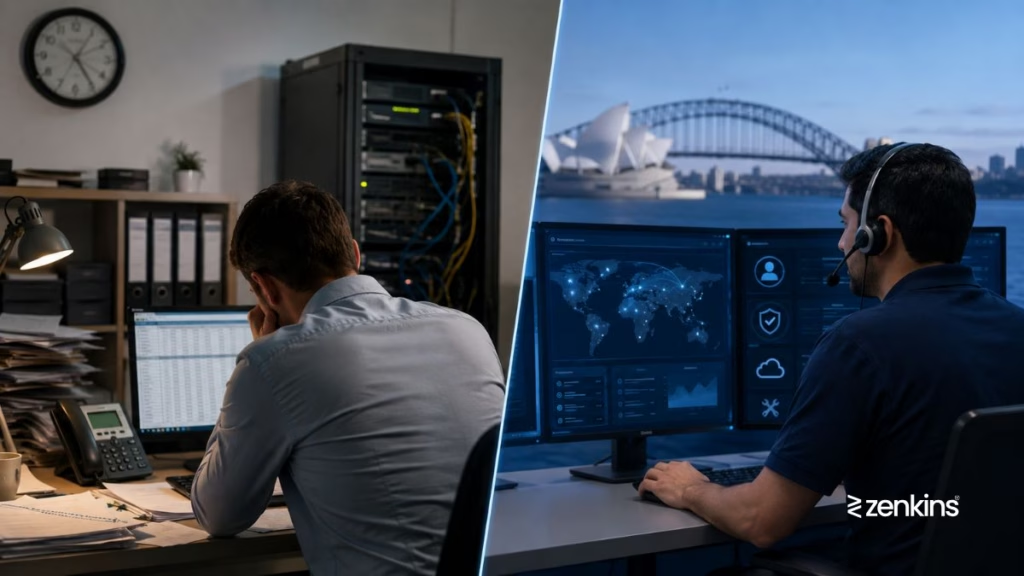
How Managed IT teams prevent downtime is a critical concern for businesses that rely on always-on systems, digital workflows, and uninterrupted customer experiences. Downtime is no longer just an IT issue. It directly impacts revenue, employee productivity, customer trust, and regulatory compliance.
This knowledge-based guide explains how Managed IT teams prevent downtime through structured processes, proactive technologies, and disciplined operational practices that keep systems stable, secure, and resilient.
Why Downtime Prevention Matters in Modern IT Environments
Understanding how Managed IT teams prevent downtime starts with recognizing the true cost of outages.
Downtime can result in:
- Lost revenue and missed transactions
- Reduced employee productivity
- Customer dissatisfaction and churn
- Data integrity and security risks
- Compliance and audit exposure
Managed IT teams focus on prevention rather than recovery. Their goal is to stop incidents before users ever notice an issue.
Proactive Monitoring as the Foundation
1. Continuous System Monitoring
One of the primary ways how Managed IT teams prevent downtime is through 24/7 system monitoring.
Managed IT teams continuously monitor:
- Servers and virtual machines
- Cloud infrastructure
- Network devices
- Storage systems
By tracking performance metrics such as CPU usage, memory consumption, disk capacity, and latency, potential failures are identified early and resolved before they escalate into outages.
2. Intelligent Alerting and Threshold Management
Monitoring alone is not enough. Managed IT teams configure intelligent alerts that trigger action before thresholds are breached.
This approach ensures:
- Early detection of abnormal behavior
- Reduced alert noise
- Faster response to genuine risks
This disciplined alerting strategy is central to how Managed IT teams prevent downtime at scale.
Infrastructure Resilience and Redundancy
3. High Availability and Failover Design
Another critical element of how Managed IT teams prevent downtime is infrastructure resilience.
Managed IT teams design environments with:
- Redundant servers and network paths
- Load balancing for critical applications
- Automated failover mechanisms
- Backup power and connectivity
When failures occur, systems continue operating without service interruption.
4. Capacity Planning and Resource Optimization
Downtime often results from exhausted resources rather than hardware failure.
Managed IT teams continuously analyze trends to:
- Predict capacity constraints
- Optimize resource utilization
- Scale infrastructure proactively
This prevents performance degradation and unplanned outages caused by growth or usage spikes.
Preventive Maintenance and Patch Management
5. Regular System Maintenance
A key reason how Managed IT teams prevent downtime effectively is disciplined preventive maintenance.
This includes:
- Hardware health checks
- Disk cleanup and optimization
- Log management
- Firmware and OS updates
Preventive maintenance reduces the likelihood of unexpected failures.
6. Patch and Update Management
Unpatched systems are a leading cause of downtime and security incidents.
Managed IT teams:
- Monitor patch releases
- Test updates in controlled environments
- Schedule updates during low-impact windows
This structured approach ensures stability while maintaining security.
Application and Dependency Management
7. Application Performance Monitoring
Applications are often the first point where users experience downtime.
Managed IT teams monitor:
- Application response times
- Error rates and crashes
- Database performance
- Third-party service dependencies
This visibility is essential to how Managed IT teams prevent downtime in business-critical systems.
8. Dependency Mapping and Root Cause Analysis
Modern applications rely on multiple interconnected components.
Managed IT teams map dependencies to:
- Identify single points of failure
- Resolve root causes faster
- Prevent cascading failures
This proactive analysis reduces repeat incidents and improves overall system stability.
Security-Driven Downtime Prevention
9. Threat Detection and Incident Prevention
Security incidents frequently lead to downtime.
Managed IT teams prevent downtime by:
- Monitoring suspicious activity
- Blocking threats before damage occurs
- Detecting ransomware and malware early
Security monitoring is a core pillar of how Managed IT teams prevent downtime in regulated and high-risk environments.
10. Backup, Disaster Recovery, and Business Continuity
Even with strong prevention, failures can still occur.
Managed IT teams ensure:
- Automated and verified backups
- Regular disaster recovery testing
- Defined recovery time and recovery point objectives
This ensures rapid recovery with minimal disruption.
Automation and Proactive Remediation
11. Automated Issue Resolution
Automation plays a major role in how Managed IT teams prevent downtime.
Examples include:
- Automatically restarting failed services
- Scaling resources during peak demand
- Clearing disk space before limits are reached
Automation reduces response time and eliminates human delay.
Governance, Reporting, and Continuous Improvement
12. Performance Reporting and Trend Analysis
Managed IT teams use reporting to prevent future downtime.
Reports provide insights into:
- Recurring issues
- Performance bottlenecks
- Improvement opportunities
This data-driven approach strengthens long-term system reliability.
The Zenkins Approach to Downtime Prevention
At Zenkins, downtime prevention is built into every managed IT engagement.
Our teams focus on:
- Proactive monitoring and alerting
- Resilient infrastructure design
- Preventive maintenance and automation
- Security-first operations
This structured model ensures clients experience fewer incidents, faster resolution, and predictable IT performance.
Conclusion
Understanding how Managed IT teams prevent downtime helps businesses appreciate the value of proactive IT management.
Downtime prevention is not a single tool or activity. It is a disciplined combination of monitoring, maintenance, automation, security, and continuous improvement. With the right managed IT partner, downtime becomes the exception rather than the expectation.