
Table of Contents
Introduction: Why Businesses Outsource Helpdesk Agents for 24/7 IT Support
In today’s business world, technology is at the heart of every operation. From employee productivity tools to customer-facing applications, IT systems need to function smoothly and efficiently around the clock. When systems fail, employees struggle, and customer experiences suffer. This is where helpdesk agents play a critical role—ensuring uninterrupted IT support, resolving incidents quickly, and keeping business operations stable.
But here’s the challenge: running an in-house 24/7 IT helpdesk is expensive, resource-heavy, and often inefficient for most organizations. This has led many enterprises, startups, and SMEs to outsource helpdesk agents to specialized providers like Zenkins, where skilled IT professionals are available on-demand, day and night, at a fraction of the cost.
This blog explores why businesses outsource helpdesk agents for 24/7 IT support, the benefits of doing so, the roles covered, and how Zenkins can help you set up a reliable IT helpdesk outsourcing model.
Why Helpdesk Agents Are Critical to Business Continuity
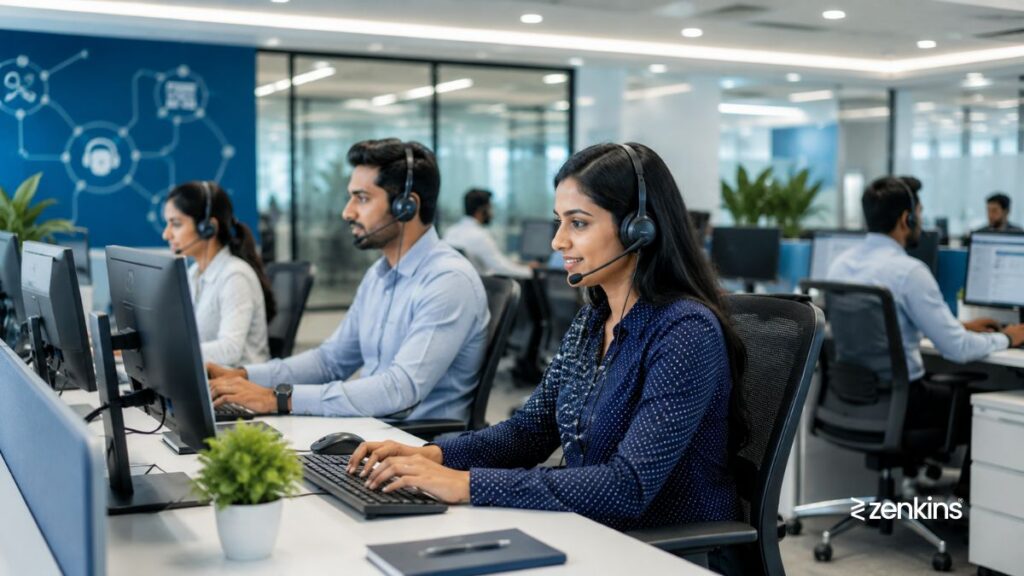
A helpdesk agent is often the first point of contact when employees or customers face IT issues. From password resets to handling server incidents, they are responsible for minimizing downtime and maintaining user satisfaction. Their role goes far beyond basic troubleshooting—they act as the backbone of IT service delivery.
Key Responsibilities of Helpdesk Agents:
- Incident Management – Identifying, logging, and resolving IT issues quickly.
- Problem Escalation – Escalating critical issues to L2 or L3 support teams.
- System Monitoring – Tracking performance, uptime, and service reliability.
- Customer Communication – Keeping users informed with empathy and clarity.
- Documentation & Reporting – Ensuring IT compliance and service records.
Without a robust helpdesk, small IT issues can spiral into major disruptions, leading to productivity loss, security risks, and unhappy customers.
Why Businesses Outsource Helpdesk Agents Instead of Hiring In-House
Many organizations start with in-house IT helpdesk support but quickly realize the limitations. Outsourcing offers a scalable, cost-effective, and round-the-clock model that aligns with modern business demands.
1. Cost Efficiency
Running an internal helpdesk means salaries, training, infrastructure, licenses, and management overhead. Outsourcing eliminates these fixed costs by converting them into a predictable monthly service fee.
2. 24/7 Availability
An internal IT team often operates only during business hours. But IT issues don’t follow a 9-to-5 schedule. With outsourced helpdesk agents, businesses get 24/7 IT support across time zones.
3. Access to Skilled Talent
Outsourcing partners like Zenkins provide trained L1, L2, and specialized IT engineers, reducing the burden of constant hiring and retraining.
4. Faster Response and Resolution
Outsourced helpdesk teams follow ITIL-based processes, ensuring quick ticket handling, escalation, and resolution.
5. Scalability
As your business grows, outsourcing makes it easy to scale up or down support resources without worrying about recruitment delays.
6. Focus on Core Business
With the helpdesk managed externally, internal teams can focus on innovation, product development, and customer growth.
Types of Helpdesk Roles Businesses Commonly Outsource
Outsourcing covers a wide range of roles, each contributing to seamless IT support operations. Businesses can outsource roles such as:
- Helpdesk Agents / IT Service Desk Engineers – First-line support for all IT issues.
- Incident Management Representatives (ITIL-based) – Handling escalation and service recovery.
- Desktop Engineers (L1/L2/VIP Support) – Onsite and remote end-user device support.
- System Administrators – Server, storage, and infrastructure support.
- Network Engineers (L1/L2) – Managing LAN/WAN, firewalls, and connectivity.
- Application Support Analysts – Handling business applications and integrations.
- Customer Support Engineers – Bridging IT and customer-facing problem-solving.
- Cloud & Office 365 Engineers – Supporting cloud migration, collaboration tools, and SaaS platforms.
- Information Security Officers / IAM Analysts – Managing identity, access, and IT security.
- Resident Engineers – Dedicated support at client premises.
By outsourcing these roles, organizations get specialized expertise at scale without the delays of recruitment.
Benefits of 24/7 IT Support Through Outsourced Helpdesk Agents
When organizations outsource helpdesk services, the primary advantage is round-the-clock IT support. Here’s what businesses gain:
1. Zero Downtime Business Operations
Outsourced teams work across shifts, ensuring incidents are resolved at any hour.
2. Improved Customer Experience
Customers expect seamless digital experiences—24/7 IT support ensures issues never disrupt service availability.
3. Global Business Continuity
For businesses with international clients, outsourcing ensures support coverage across time zones.
4. Enhanced Security & Compliance
Outsourced teams follow strict compliance (GDPR, HIPAA, ISO standards) and ensure security incidents are promptly handled.
5. Data-Driven IT Management
With outsourced helpdesk solutions, businesses get ticket analytics, SLA tracking, and performance reports for smarter IT decisions.
How to Get Started with Zenkins Helpdesk Outsourcing
Zenkins makes outsourcing IT helpdesk agents simple, flexible, and highly customized. Whether you need a single L1 support engineer or a complete 24/7 IT helpdesk team, the setup is seamless.
Step 1: Define Your Support Needs
We start by analyzing your current IT support model:
- What issues occur most frequently (password resets, hardware, applications, etc.)?
- Do you need 24/7 support, or specific shift-based coverage?
- What level of expertise is required (L1, L2, L3, or specialized engineers)?
This assessment ensures Zenkins builds a customized outsourcing plan for your business.
Step 2: Role Mapping and Resource Planning
Based on your requirements, Zenkins maps roles to your business needs. For example:
- Helpdesk Agents for frontline issue resolution.
- Incident Managers for ITIL-compliant incident workflows.
- Resident Engineers for onsite support where needed.
- Cloud/Network Experts for specialized environments.
Every outsourced role comes with a clear SLA for response time, resolution time, and reporting.
Step 3: Onboarding and Knowledge Transfer
Zenkins ensures a structured onboarding process, including:
- Understanding your IT infrastructure and applications.
- Creating escalation workflows for critical incidents.
- Aligning reporting and ticketing systems with your business tools (ServiceNow, Jira, Freshdesk, Zoho Desk, etc.).
This minimizes downtime during the transition phase.
Step 4: Service Transition & Go-Live
Once onboarding is complete, Zenkins deploys a dedicated or shared team to start managing IT support. This includes:
- 24/7 coverage or shift-based coverage.
- Multichannel support (phone, chat, email, ticketing).
- Defined escalation paths to senior engineers.
Step 5: Continuous Monitoring & Optimization
Outsourcing with Zenkins doesn’t stop at deployment—we continuously monitor performance, SLA compliance, and ticket resolution times. Regular reviews ensure your business gets ongoing IT improvement.
Step 6: Scaling As Your Business Grows
As your IT landscape evolves, Zenkins can scale the helpdesk team—adding more engineers, expanding skill sets, or enhancing coverage hours. This flexibility ensures your IT support grows in line with your business.
FAQs on Outsourcing Helpdesk Agents for 24/7 IT Support
What does it mean to outsource helpdesk agents?
Outsourcing helpdesk agents means hiring an external IT service provider to manage your technical support, incident resolution, and IT helpdesk functions. Instead of maintaining a full in-house support team, businesses partner with providers like Zenkins to deliver 24/7 IT support at lower costs.
Why do businesses outsource helpdesk services instead of keeping them in-house?
Running an in-house IT helpdesk requires constant hiring, training, infrastructure, and high salaries. Outsourcing provides skilled IT support engineers on-demand with round-the-clock availability, allowing businesses to reduce costs while ensuring faster issue resolution.
What roles can be outsourced under IT helpdesk support?
Organizations can outsource roles like Helpdesk Agents, IT Support Engineers (L1/L2), Desktop Engineers, Incident Managers, Application Support Analysts, Network Engineers, Cloud Support Engineers, and Resident Engineers.
Can outsourced helpdesk agents provide 24/7 IT support?
Yes. A major advantage of outsourcing is round-the-clock coverage. External teams work in shifts, ensuring IT incidents are resolved anytime, across multiple time zones, without burdening your internal staff.
How does outsourced helpdesk support improve business continuity?
By ensuring zero downtime, faster ticket resolution, proactive monitoring, and ITIL-based incident management, outsourced helpdesk agents prevent small IT issues from turning into major business disruptions.
What industries benefit the most from outsourcing helpdesk support?
Industries such as finance, banking, healthcare, retail, manufacturing, eCommerce, telecom, and professional services rely heavily on IT systems and often choose outsourced helpdesk services to ensure uninterrupted operations and compliance.
How secure is outsourced IT helpdesk support?
Reputed providers like Zenkins follow strict data security, compliance, and access control policies (ISO, GDPR, HIPAA). All support activities are monitored, logged, and reported to ensure maximum security and transparency.
How quickly can a business set up outsourced helpdesk support with Zenkins?
Depending on the requirements, Zenkins can deploy dedicated or shared helpdesk agents within days or weeks. A structured onboarding process ensures smooth knowledge transfer and minimal disruption to business operations.
Can outsourced helpdesk teams integrate with our existing IT systems?
Yes. Outsourced teams work with tools like ServiceNow, Jira, Freshdesk, Zoho Desk, and Microsoft Teams to integrate seamlessly into your workflows. Zenkins adapts to your existing infrastructure instead of forcing new systems.
What’s the difference between L1 and L2 helpdesk agents?
L1 Helpdesk Agents handle basic issues such as password resets, software installations, and general troubleshooting.
L2 Helpdesk Agents manage more complex problems involving servers, networks, and escalated incidents.
Both levels can be outsourced based on business needs.
How does outsourcing help with IT cost savings?
Outsourcing reduces the cost of recruitment, salaries, infrastructure, licensing, and management overhead. Instead, businesses pay a predictable monthly service fee while accessing a wide pool of IT expertise.
Is helpdesk outsourcing suitable for small and mid-sized businesses?
Absolutely. SMBs often lack resources to run a 24/7 in-house IT helpdesk. Outsourcing offers them enterprise-level IT support at affordable rates, helping them scale without operational risks.
Final Thoughts
In today’s always-connected world, 24/7 IT support is no longer optional—it’s essential. Businesses that rely on in-house teams often face high costs, skill gaps, and limited availability. By choosing to outsource helpdesk agents, organizations gain reliable, round-the-clock support while reducing costs and improving service quality.
With Zenkins, businesses don’t just get IT helpdesk outsourcing—they get a long-term partner that ensures seamless IT operations, business continuity, and customer satisfaction.