
Table of Contents
In the age of digital globalization, businesses can’t afford downtime. Users expect instant support, systems must stay online, and customer satisfaction has become a key differentiator.
That’s why India based IT helpdesk support has become the backbone of global operations — offering cost efficiency, technical expertise, and round-the-clock service delivery.
Whether you’re a startup expanding globally or an enterprise optimizing IT operations, partnering with an India-based helpdesk provider like Zenkins ensures uninterrupted support and measurable service quality.
In this in-depth guide, we’ll explore what makes India the preferred hub for IT helpdesk services, best practices for running 24/7 global operations, and how to choose the right partner for sustainable success.
Understanding India-Based IT Helpdesk Support
IT helpdesk support acts as the first line of defense for end-user and infrastructure issues.
It handles everything from troubleshooting login errors, software installations, and printer connectivity to more complex problems like VPN access, DMS management, and endpoint security.
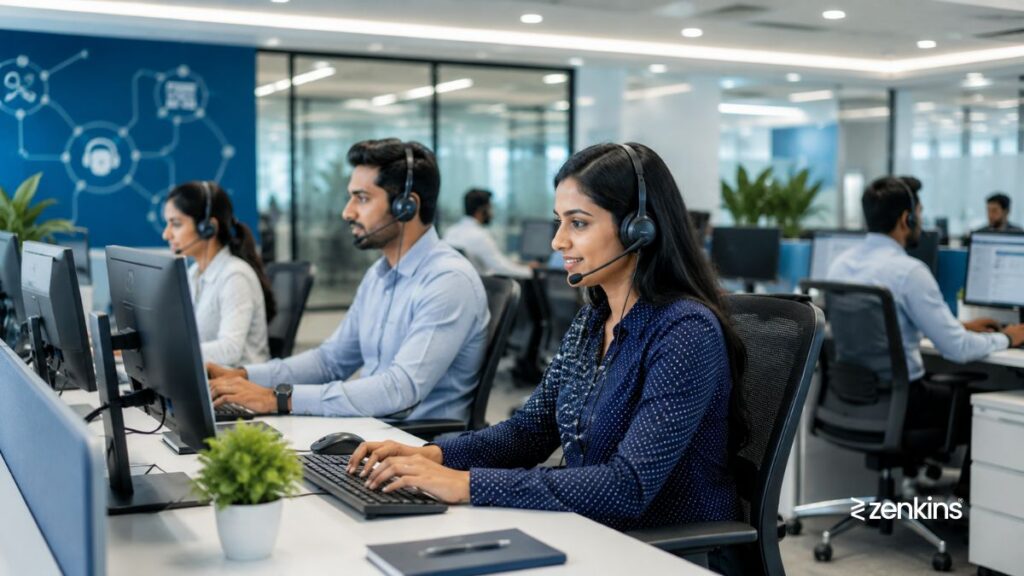
An India based IT helpdesk support model allows companies to outsource these functions to specialized teams located in India. These teams provide 24/7 user support through email, chat, and call channels — ensuring business continuity across different time zones.
India has emerged as a global leader in managed IT services due to:
- Skilled technical talent
- English proficiency
- Cost-effective operations
- ITIL and ISO-certified support processes
- Proven experience serving global enterprises
This combination makes Indian helpdesk support teams indispensable for global organizations aiming to maintain performance and reduce operational overheads.
Why Global Businesses Choose India for IT Helpdesk Support
India is not just a cost advantage — it’s a strategic advantage.
Let’s understand why the world’s top enterprises continue to build or outsource their helpdesk operations here.
1. Cost Efficiency Without Compromising Quality
The operational cost of setting up and managing an IT helpdesk in India is significantly lower — often 40% to 60% less than maintaining in-house teams in the US, UK, or Europe.
However, this doesn’t mean cutting corners. Indian teams are trained in international ITSM frameworks and deliver enterprise-grade service.
2. 24/7 Global Service Capability
With India’s time zone advantage, helpdesk teams can easily provide follow-the-sun support models — ensuring seamless 24/7 availability.
When your onshore teams log off, your offshore Indian team takes over — keeping ticket resolution and user satisfaction consistent.
3. Strong English Communication and Cultural Fit
India’s strong focus on English-medium education and global exposure ensures that communication is clear, polite, and user-friendly — a critical factor in IT support interactions.
4. Scalable and Skilled Workforce
India’s IT industry employs over 4 million professionals, including a deep pool of L1, L2, and L3 engineers.
This scalability allows organizations to ramp up support quickly, whether it’s seasonal demand, new product launches, or enterprise rollouts.
5. Advanced Infrastructure and Security
Modern IT helpdesk centers in India operate with secure networks, redundant power systems, and enterprise-grade data protection standards — aligning with GDPR, HIPAA, and ISO/IEC 27001 requirements.
6. Process-Driven and KPI-Focused Support
Indian helpdesk partners like Zenkins follow ITIL-aligned processes, focusing on measurable outcomes like:
- First Call Resolution (FCR)
- Mean Time to Resolve (MTTR)
- Customer Satisfaction (CSAT)
- SLA adherence
These metrics drive transparency and continuous improvement.
The Structure of a Modern IT Helpdesk
To deliver world-class support, a helpdesk needs a clear structure and escalation hierarchy.
Here’s how a typical India based IT helpdesk support system is organized:
L1 – First-Level Support
Handles general user issues:
- Password resets
- Email configuration
- Printer, VPN, Wi-Fi issues
- Application access and KCO App support
L2 – Second-Level Support
Tackles more complex, technical issues such as:
- Network troubleshooting
- Server or OS issues
- DMS and Active Directory configuration
- Endpoint security
L3 – Advanced Technical Support / Engineering
Provides deep technical fixes, root cause analysis, and system-level configuration.
These teams coordinate with software engineers, DevOps, and infrastructure specialists.
By outsourcing to an India-based L1/L2 team, global companies can reduce the load on their core technical staff and improve efficiency across all levels.
Key Best Practices for 24/7 Global Service Delivery
Delivering 24/7 global helpdesk support requires more than just extended working hours — it’s about process maturity, cultural alignment, and continuous optimization.
Here are best practices Zenkins recommends for success:
Establish a “Follow-the-Sun” Support Model
To ensure uninterrupted global coverage:
- Distribute shifts across India-based teams to align with multiple time zones.
- Use rotating schedules to maintain team productivity and prevent burnout.
- Document handover processes for smooth shift transitions.
Invest in Multichannel Support
Users expect flexibility.
Offer multiple support channels:
- Email / Ticketing (ITSM tools like Jira, ServiceNow, Freshservice)
- Live Chat Support
- Voice (Toll-free or VoIP-based calls)
- Self-service portals and knowledge bases
This improves user satisfaction and reduces ticket load through self-help automation.
Define Clear SLAs and KPIs
Service quality depends on measurable goals.
Key metrics to monitor include:
- Average response time
- First contact resolution rate
- Escalation rate
- Customer satisfaction (CSAT)
- SLA compliance percentage
These help track team performance and optimize resource allocation.
Create a Centralized Knowledge Base
A shared, searchable repository of solutions helps speed up ticket resolution.
It also enables new team members to ramp up faster and ensures consistent responses.
Leverage ITIL Framework for Process Consistency
Adopting ITIL ensures that incident management, problem management, and change management follow standardized, globally accepted practices.
Prioritize Continuous Training
Technical tools and business processes evolve rapidly.
Provide regular training for helpdesk agents on:
- New applications and devices
- Soft skills (communication, empathy)
- Security and compliance updates
Integrate Helpdesk Automation
AI chatbots, automated ticket routing, and knowledge article suggestions can dramatically improve response times and reduce manual effort — especially for repetitive issues.
Enable Remote Work Capability
With cloud-based ITSM systems and secure VPNs, Indian helpdesk teams can operate remotely without affecting SLAs.
This flexibility ensures business continuity during disruptions like pandemics or local outages.
Foster Transparent Client Communication
Provide regular reporting on ticket volumes, SLA performance, and user feedback.
Transparency builds trust and encourages collaborative problem-solving.
How India’s Time Zone Advantage Powers 24/7 Support
The geographical positioning of India (GMT+5:30) allows overlapping work hours with Europe in the morning and the US in the evening.
This creates a near-seamless 24-hour support cycle when combined with onshore teams — commonly known as the “Follow-the-Sun” model.
Example:
- European users supported during India’s morning hours
- North American users supported during India’s evening hours
- Asia-Pacific region covered throughout the day
This operational model ensures zero downtime and faster response rates for global businesses.
Industries Benefiting Most from India-Based IT Helpdesk Support
While IT helpdesk outsourcing is universal, certain sectors gain exceptional value:
- Healthcare – 24/7 patient data access, EMR system support, and compliance-focused IT services
- Finance & Banking – Secure infrastructure monitoring, endpoint support, and application troubleshooting
- eCommerce – Round-the-clock customer and backend support during peak sales
- Manufacturing – IoT device monitoring, ERP system management, and production uptime assurance
- Education – Remote learning platform support and user onboarding
With domain-trained agents, Zenkins tailors IT helpdesk services to specific industry workflows and tools.
Technology and Tools Empowering India Based IT Helpdesk Teams
Modern helpdesk operations rely on a robust ecosystem of technologies to streamline workflows:
- Ticketing & ITSM Tools – ServiceNow, Jira Service Management, Freshservice, ManageEngine
- Monitoring Tools – SolarWinds, Nagios, Datadog, Zabbix
- Communication Platforms – Microsoft Teams, Zoom, Slack, Google Meet
- Remote Access Tools – AnyDesk, TeamViewer, BeyondTrust
- Automation & AI Tools – ChatGPT-powered chatbots, workflow automation, predictive analytics
Zenkins integrates these technologies with custom dashboards for real-time performance visibility.
Data Security and Compliance in IT Helpdesk Outsourcing
Security is non-negotiable in IT support.
When outsourcing to an India-based IT helpdesk, ensure your vendor follows strict protocols:
- NDAs with all staff and sub-vendors
- Encrypted communication (VPN, SSL, MFA)
- Role-based access control
- Regular security audits
- Compliance with GDPR, ISO 27001, SOC 2, and client-specific standards
At Zenkins, every helpdesk engagement includes a data protection agreement (DPA) and secure onboarding process for peace of mind.
KPIs to Measure Helpdesk Success
Tracking performance ensures continuous improvement.
Essential KPIs include:
| KPI | Description | Ideal Target |
|---|---|---|
| First Contact Resolution | Percentage of tickets resolved on first contact | 70%+ |
| SLA Compliance | Tickets closed within SLA timelines | 95%+ |
| Customer Satisfaction (CSAT) | User feedback rating | 4.5/5 or higher |
| Mean Time to Resolve (MTTR) | Average time taken per ticket | As per priority level |
| Ticket Backlog | Pending tickets beyond SLA | <5% |
| Agent Utilization | Productive vs idle time | 80% |
These metrics help optimize staffing, improve response quality, and drive accountability.
How to Choose the Right India-Based IT Helpdesk Partner
Selecting the right partner defines your support experience.
Evaluate vendors based on the following criteria:
- Experience and Domain Expertise – Choose providers familiar with your industry and tools.
- Scalability – Ensure they can quickly ramp resources as your business grows.
- Certifications and Compliance – Verify adherence to ISO, ITIL, and GDPR.
- Support Channels and Languages – Multilingual support if you serve global users.
- Transparent Reporting – Access to dashboards and weekly/monthly SLA reports.
- Cultural Compatibility – Empathy, clarity, and alignment with your company’s tone.
- Flexible Engagement Models – Options like Dedicated Team, Shared Support, or Managed Services.
Zenkins offers all three engagement models, customized to your operations — whether you need 24/7 coverage, extended-hour support, or a hybrid L1/L2 setup.
Zenkins: Your Trusted Partner for India-Based IT Helpdesk Support
At Zenkins, we help enterprises and startups streamline IT operations with managed helpdesk support services.
Our India-based teams deliver 24/7 global assistance, covering everything from user ticket management to complex L2/L3 technical support.
Our key differentiators include:
- ITIL-certified helpdesk experts
- Dedicated account management and SLA-driven delivery
- 24/7 availability across multiple time zones
- Transparent performance tracking and analytics
- Support for diverse tools like O365, Zoho, DMS, and custom enterprise applications
With Zenkins as your helpdesk partner, you get the reliability of an in-house team combined with the scalability and cost benefits of offshore support.
Frequently Asked Questions (FAQs)
What is India-Based IT Helpdesk Support?
India-based IT Helpdesk Support refers to remote or offshore technical assistance provided by teams located in India. These teams handle end-user issues, IT incidents, service requests, and system monitoring for global clients. It includes 24/7 support across different time zones, leveraging India’s skilled workforce and cost-effective operations.
Why do global businesses prefer India for IT Helpdesk Support?
Businesses choose India due to its combination of high-quality technical talent, round-the-clock availability, multilingual capabilities, cost savings (up to 60%), and strong IT infrastructure. India’s service providers also maintain ITIL-aligned processes and ISO-certified operations, ensuring enterprise-grade service delivery.
What are the typical services offered by India-based IT Helpdesk teams?
India-based IT Helpdesk teams typically handle:
– L1 support: password resets, printer/Wi-Fi issues, user account access, email configuration.
– L2/L3 support: deeper troubleshooting, system upgrades, patching, and escalations.
– Remote desktop assistance for end users.
– Incident and service request management via ITSM tools.
– Monitoring and reporting on system uptime and SLAs.
– Asset and user management for hybrid or remote teams.
How does 24/7 global service delivery work from India?
India’s helpdesk teams operate in rotational shifts, ensuring continuous support for clients across North America, Europe, Asia, and the Middle East. Using advanced ticketing systems (like ServiceNow, Freshservice, or Zoho Desk) and remote monitoring tools (like SolarWinds, ManageEngine, or Splashtop), they maintain seamless communication and resolution workflows around the clock.
What are the key benefits of outsourcing IT helpdesk to India?
Some of the biggest advantages include:
– Significant cost savings compared to in-house teams.
– 24×7 availability for global coverage.
– Faster ticket resolution using established processes and automation.
– Access to a skilled workforce with technical certifications (CompTIA, Microsoft, ITIL).
– Scalability to handle seasonal workload variations.
– Focus on core business while experts handle IT support.
How do Indian IT helpdesk providers maintain service quality?
Top providers in India follow ITIL frameworks, SLA-based delivery models, and continuous service improvement (CSI) practices. They conduct regular training, monitor first-call resolution (FCR) and mean time to resolution (MTTR), and use AI-driven analytics for proactive issue prevention. Many providers also undergo ISO 27001 and SOC 2 audits for compliance.
What tools and technologies are commonly used in India-based IT Helpdesk operations?
Commonly used platforms include:
– Ticketing & ITSM tools: ServiceNow, Jira Service Management, Zoho Desk, Freshservice.
– Remote access tools: AnyDesk, TeamViewer, Splashtop, RemotePC.
– Monitoring systems: ManageEngine, Nagios, SolarWinds.
– Communication tools: Microsoft Teams, Slack, Zoom.
– Automation platforms: Power Automate, Chatbots, RPA tools for faster ticket triage.
How do Indian IT helpdesk teams handle data security and privacy?
Security is ensured through:
– Strict access controls and audit trails.
– VPN-encrypted remote connections.
– Compliance with GDPR, HIPAA, and ISO 27001 standards.
– Regular vulnerability assessments and penetration tests.
– Dedicated client data segregation within ITSM tools.
What are the common challenges in managing global IT support from India?
Key challenges include:
– Cultural and communication gaps between regions.
– Time zone coordination for real-time collaboration.
– Maintaining consistent service quality across multiple clients.
– Training on client-specific tools and environments.
Leading providers overcome these by adopting strong onboarding programs, English proficiency training, and local client liaisons for smoother collaboration.
How can businesses transition to India-based IT Helpdesk support smoothly?
To ensure a smooth transition:
– Define clear SLAs and KPIs.
– Conduct knowledge transfer sessions with the new team.
– Use a phased migration plan (e.g., pilot → full rollout).
– Maintain shadow support during the transition.
– Set up regular review meetings to monitor performance and resolve bottlenecks.
What is the difference between onsite, offshore, and hybrid IT helpdesk models?
– Onsite: Support staff located within the client’s office.
– Offshore (India-based): Entirely remote support from India.
– Hybrid: A mix of onsite coordination (client-side) and offshore execution (India), combining the benefits of both models — proximity and scalability.
Why choose Zenkins for India-Based IT Helpdesk Support?
Zenkins offers customized 24/7 helpdesk outsourcing solutions with L1, L2, and L3 coverage for enterprises and startups worldwide.
– Proven experience supporting global users across time zones
– English-speaking, ITIL-certified engineers
– Flexible pricing models (per-ticket, per-seat, or dedicated team)
– Expertise in incident management, user onboarding, cloud support, and IT automation
Zenkins ensures high availability, quick resolutions, and cost efficiency — making it a trusted partner for India-based IT Helpdesk Support.
Final Thoughts
In today’s digital-first world, IT downtime can cost more than just lost productivity — it can damage reputation, customer trust, and revenue.
That’s why global businesses are choosing India-based IT helpdesk support to ensure their systems and users are always up and running.
The key to success lies in choosing a trusted, process-driven partner who understands both your business and your users.
Zenkins stands ready to help you deliver seamless 24/7 global IT support, built on reliability, transparency, and continuous improvement.