Table of Contents
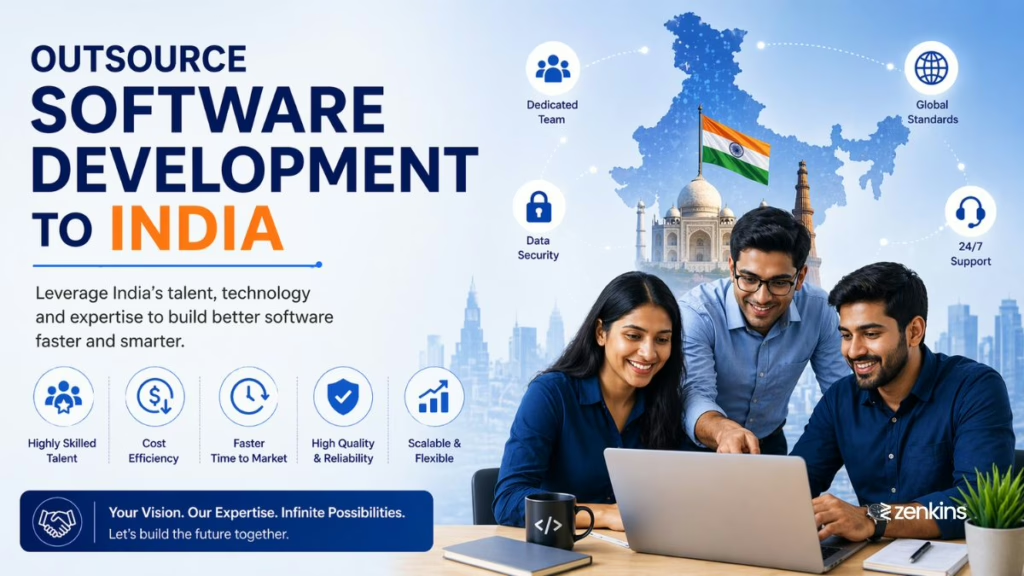
For IT managers operating under tightening budgets and growing delivery backlogs, outsourcing software, ERP, and web development to India has become one of the most practical cost reduction strategies available. India’s combination of large engineering talent pools, strong English communication, and mature outsourcing infrastructure makes it the world’s leading destination for IT outsourcing — and has been for over two decades.
This playbook gives you the numbers, the models, the process, and the guardrails to outsource to India effectively — cutting costs without cutting corners.
Why India Remains the Top Destination for IT Outsourcing in 2026
Before diving into the how, it helps to understand why India continues to dominate global IT outsourcing despite competition from Eastern Europe, Southeast Asia, and Latin America.
Talent at scale. India produces over 1.5 million engineering graduates annually. This creates a talent density that no other country currently matches — particularly in software development, ERP implementation, and web technologies.
Cost advantage. Fully loaded development costs in India — including salary, benefits, infrastructure, and management overhead — typically run 60 to 70 percent below equivalent costs in the US or UK. This gap narrows slightly for highly specialised roles but remains substantial across almost every technology category.
English language proficiency. India ranks among the highest non-native English-speaking countries globally, which significantly reduces communication friction in client-vendor relationships.
Time zone coverage. Teams based in India can provide overlap with UK business hours during morning shifts and with US East Coast hours during evening shifts, enabling near-synchronous collaboration without requiring night shifts on the client side.
Mature outsourcing ecosystem. India has decades of experience delivering enterprise software projects for global clients. This means established delivery methodologies, contract structures, IP protection frameworks, and escalation processes that newer outsourcing destinations simply cannot match.
What Are the Actual Cost Savings When Outsourcing to India?
Cost comparisons in outsourcing are often presented as rough percentages. This section gives you more grounded numbers to use in your business case.
Custom Software Development
A mid-level software developer in the US commands a fully loaded cost of approximately $120,000 to $160,000 per year including salary, benefits, payroll taxes, office space, and equipment. A developer of equivalent skill level at an Indian outsourcing firm typically costs $18,000 to $35,000 per year on a time-and-materials or dedicated team model.
For a team of five developers, that represents an annual saving of $425,000 to $600,000 — before accounting for the reduced recruitment, HR, and management overhead of using an outsourced team versus building in-house.
ERP Development and Customisation
ERP consultants and developers in Western markets typically bill at $150 to $250 per hour. Indian ERP specialists with comparable platform expertise — for Microsoft Dynamics, SAP Business One, Oracle NetSuite, or Zoho ERP — typically bill at $25 to $55 per hour.
For a 2,000-hour ERP customisation project, this translates to a cost of $50,000 to $110,000 when outsourced to India versus $300,000 to $500,000 for equivalent work delivered by a Western consultancy.
Web and Web Application Development
Web development rates in India vary significantly by complexity and stack. A mid-level full-stack developer with React, Node.js, or .NET experience typically costs $20 to $40 per hour through a reputable outsourcing vendor. The same profile in the UK or Australia commands $80 to $150 per hour.
For a 6-month web application project involving a team of three developers, the cost difference can easily exceed $200,000.
The Three Outsourcing Models — and Which One Reduces Costs Most Effectively
IT managers often focus on the hourly rate differential between onshore and offshore development. The total cost reduction available to you, however, depends significantly on which engagement model you choose.
Fixed-Price Model
In a fixed-price model, you agree on a defined scope and a fixed budget before work begins. The vendor absorbs the risk of overruns — in theory.
Best for: Short, well-defined projects with stable requirements. Simple web builds, specific ERP modules, or bounded custom tools.
Cost reduction profile: High budget predictability, but limited flexibility. If your requirements change, change requests can erode savings quickly.
Caution: Fixed-price models incentivise vendors to cut scope or quality when projects run over. Ensure your contract includes acceptance criteria and defect warranty periods.
Time and Materials (T&M)
In a T&M model, you pay for actual hours worked at an agreed rate. This gives you flexibility to change direction as requirements evolve.
Best for: Projects where scope is likely to evolve — ERP customisations, product roadmaps, iterative web application builds.
Cost reduction profile: The hourly rate differential with India is fully captured, but active oversight is required to manage scope.
Cost control tip: Set a monthly budget ceiling and require weekly timesheets with task-level breakdowns. This gives you spend visibility without sacrificing flexibility.
Dedicated Team / Extended Team
In a dedicated team model, you engage a fixed squad of developers — typically through a monthly retainer — who work exclusively on your account. The team operates as an extension of your in-house IT function.
Best for: Ongoing development workloads, long-term ERP maintenance, product companies with continuous roadmaps.
Cost reduction profile: The most cost-efficient model for sustained workloads. Monthly team costs are predictable, and productivity improves over time as the team builds domain knowledge.
Additional benefit: Dedicated teams build institutional knowledge of your systems, reducing knowledge transfer costs and ramp-up time compared to project-based models.
For most IT managers managing a combination of software, ERP, and web development work, a dedicated team model for the core workload — supplemented by fixed-price engagements for discrete projects — delivers the best long-term cost outcome.
How to Build the Business Case for Outsourcing to India
IT managers often face internal resistance when proposing offshore outsourcing — from finance teams concerned about hidden costs, legal teams worried about IP, or business stakeholders concerned about quality and communication.
Here is how to structure a compelling internal business case.
Calculate the Total Cost Comparison
Do not compare hourly rates in isolation. Build a full cost comparison that includes:
Current cost (onshore or in-house):
- Fully loaded salary cost per developer (salary + benefits + taxes + overhead)
- Recruitment and onboarding cost per hire
- Management overhead
- Infrastructure and tooling costs
Outsourced cost (India-based vendor):
- Vendor billing rate (hourly or monthly)
- Your internal project management time
- Communication and coordination overhead (typically 5 to 10 percent of project hours for a well-run engagement)
- Transition and knowledge transfer costs at project start
When you include all these factors, the total cost advantage of a well-managed India-based engagement typically remains at 50 to 65 percent versus onshore delivery.
Address the Quality Concern Directly
The most common objection to outsourcing is quality. Address it with specifics:
- Reference independent ratings — India’s top software outsourcing vendors are assessed on platforms like Clutch, G2, and GoodFirms. Point to ratings and reviews.
- Propose a paid pilot engagement on a non-critical project to demonstrate quality before committing to a larger scope.
- Include contractual quality standards — code review requirements, test coverage minimums, and defect SLAs — in the vendor agreement.
Quantify the Speed-to-Delivery Advantage
Cost savings are not the only financial benefit of outsourcing to India. Faster delivery also has a financial value — products reach market sooner, internal systems come online faster, and backlogs are resolved more quickly.
If your internal team is currently operating at capacity — a situation most IT managers recognise — the cost of not outsourcing includes the opportunity cost of delayed delivery. Quantify this in your business case.
ERP Outsourcing to India: A Specific Playbook
ERP projects carry the highest stakes in the outsourcing landscape. Done well, they transform operational efficiency. Done poorly, they create disruption that takes years to recover from.
When outsourcing ERP work to India, apply this specific approach.
Choose a Vendor with Platform Certification
India has a large pool of ERP talent, but the quality varies significantly. For Microsoft Dynamics, SAP, Oracle, or any enterprise platform, require documented certification or a verifiable track record of completed implementations on that specific platform — not just general ERP experience.
Separate Implementation from Customisation Work
Standard ERP implementation (configuring out-of-the-box modules) and custom ERP development (building bespoke functionality or integrations) require different skill sets. Many vendors excel at one and struggle with the other. Assess each capability separately.
Plan the Data Migration Budget Separately
Data migration is consistently the most underbudgeted element of ERP outsourcing. In practice, data migration typically accounts for 20 to 30 percent of total ERP project effort. Budget for it explicitly and confirm that your vendor has a structured data cleansing, validation, and migration testing process.
Require a Post-Go-Live Hypercare Period
The weeks immediately after ERP go-live are the highest-risk period. Require your vendor to provide dedicated hypercare support — typically two to four weeks of heightened availability — before transitioning to a standard maintenance arrangement.
Define Integration Architecture Early
Your ERP will connect to other systems — CRM, payroll, procurement, logistics, or custom databases. Every integration point is a potential failure point. Define the integration architecture at the start of the project, not mid-implementation, and confirm that your vendor has experience with each connected system.
Web Development Outsourcing to India: Getting the Most from Your Budget
Web and web application development is the highest-volume outsourcing category for IT managers. India’s web development ecosystem is mature, competitive, and well-suited to the range of projects most IT teams need to deliver.
Define Performance Requirements Upfront
Too many web outsourcing projects fail not because of missing features but because of poor performance. Define your performance requirements at the start — page load times, concurrent user capacity, uptime SLAs, and mobile responsiveness benchmarks — and include them as contractual acceptance criteria.
Choose the Right Stack for Maintainability
India’s developer pool is deep across most mainstream web stacks — React, Angular, Vue, Node.js, Laravel, .NET, and Python. Choose a stack based on what your in-house team can maintain post-delivery, not just what the vendor prefers. If your internal team has .NET expertise, a vendor building in Node.js creates a long-term maintenance dependency you may not want.
Budget for Security Testing
Web application security is non-negotiable and is frequently treated as an optional line item in outsourcing proposals. Require OWASP compliance testing as a standard deliverable, not an add-on. The cost of a security vulnerability in production is far greater than the cost of proper testing during development.
Plan the Handover Before You Start
One of the most expensive phases of web development outsourcing is the knowledge transfer that happens when the project ends or changes hands. Require the vendor to maintain updated technical documentation throughout the engagement — not just at the end — so that handover is a process, not an event.
Governance: How to Manage an India-Based Outsourcing Engagement Without Losing Control
Cost savings disappear quickly when a poorly governed outsourcing engagement requires excessive rework, extended timelines, or expensive interventions. These governance practices protect your investment.
Weekly sprint reviews. For any Agile engagement, require a weekly sprint review with working software demonstrated — not status slides. Working software is the only reliable measure of progress.
Direct developer access. Maintain the right to communicate directly with the development team, not just the account manager. This is particularly important when technical decisions are being made that will affect long-term maintainability.
Version control and code repository access. You should have real-time access to the code repository throughout the engagement. Never allow a situation where the vendor holds the only copy of your code.
Monthly cost reviews. For T&M engagements, review actual costs against estimates monthly. Trend analysis over three to four months gives you early warning of scope creep or productivity issues.
Defined escalation paths. Know exactly who to call — and at what seniority level — when a problem arises that cannot be resolved at the project team level.
How Zenkins Delivers Cost Reduction Through India-Based Outsourcing
Zenkins is headquartered in India and has been delivering software development, ERP, and web development services to IT managers in the UK, US, Australia, and the UAE since 2015. The Zenkins model is specifically designed for IT managers who need to reduce costs without accepting reduced quality or control.
Transparent pricing. Every Zenkins engagement starts with a detailed scope document and a line-by-line cost breakdown. There are no onboarding fees, hidden infrastructure charges, or ambiguous billing milestones.
Single vendor, multiple capabilities. IT managers working with Zenkins can manage custom software development, ERP customisation, and web application development through a single vendor relationship — eliminating the coordination overhead of managing multiple specialist firms.
Dedicated team model available from day one. For IT managers with sustained workloads, Zenkins offers dedicated team engagements with monthly pricing, transparent team composition, and direct access to all team members.
Quality as a contractual commitment. Every Zenkins engagement includes defined code review processes, test coverage requirements, and defect response SLAs — not as optional add-ons, but as standard terms.
Pilot-first engagement. For IT managers evaluating Zenkins for the first time, a scoped pilot project is available to validate the working relationship before committing to a larger engagement.
What IT Managers Typically Save in the First Year
Based on typical engagement structures, IT managers outsourcing to India through Zenkins typically achieve the following outcomes in the first twelve months:
- 50 to 65 percent reduction in fully loaded development costs versus onshore hiring or Western consultancies
- 30 to 40 percent faster time to delivery for discrete projects versus building in-house capacity
- Near elimination of recruitment and onboarding costs for specialist roles
- Reduced management overhead through Zenkins’ project governance framework
These outcomes are not guaranteed and depend on project complexity, scope stability, and the quality of internal collaboration. However, they are consistent with the cost profiles of well-managed India-based outsourcing engagements across the industry.
Frequently Asked Questions
How much does it cost to outsource software development to India?
Costs vary significantly by technology stack, team size, and engagement model. As a general guide, a dedicated mid-level developer in India typically costs $2,000 to $4,000 per month through a reputable outsourcing vendor. Senior specialists and architects command higher rates. A full project team of five developers typically runs $12,000 to $22,000 per month all-inclusive.
Is ERP outsourcing to India reliable?
Yes — provided you choose a vendor with verified platform expertise and a structured implementation methodology. India has a large and mature pool of ERP talent across Microsoft Dynamics, SAP, Oracle, Zoho, and other enterprise platforms. The key is rigorous vendor evaluation before engagement.
How do I protect my intellectual property when outsourcing to India?
Ensure your outsourcing contract includes an explicit IP assignment clause specifying that all code, documentation, and deliverables created during the engagement are owned by you. This is standard practice for reputable Indian outsourcing vendors. Also require that all developers working on your account sign individual NDAs and that all code is stored in a repository you control.
What is the minimum team size for a dedicated team engagement?
Most vendors, including Zenkins, offer dedicated team engagements starting from a single dedicated developer. A typical starting configuration for an IT manager outsourcing a specific workstream is a team of two to three developers with a part-time project lead.
How long does it take to get a team operational in India?
With a well-prepared vendor, a dedicated team can typically be operational within two to four weeks of contract signing — including scoping, team allocation, tool setup, and initial sprint planning. This is significantly faster than the three to six months typically required to hire and onboard equivalent in-house staff.
Conclusion
Outsourcing software, ERP, and web development to India is one of the most proven cost reduction strategies available to IT managers in 2026. The cost differential is real and substantial. The talent pool is deep. The infrastructure for managing offshore engagements is mature.
The difference between outsourcing that delivers transformative cost reduction and outsourcing that creates expensive problems lies entirely in the rigour of vendor selection and engagement governance. The playbook in this guide gives you both.
If you are ready to explore what a structured outsourcing engagement could save your organisation, contact the Zenkins team for a no-obligation cost benchmarking conversation. We will help you model the savings, structure the engagement, and identify the right starting point for your specific context.
Zenkins is an India-based software development and managed IT services company serving IT managers and technology leaders in the UK, US, Australia, UAE, and India. Core services include custom software development, ERP modernisation, web application development, IT help desk outsourcing, and offshore development centre management.
About the author

Naresh D.
IT Consultant | Software Architect | Full-Stack Developer
Passionate, lifelong learner with 10+ years of experience in software development, solution architecture, and IT consulting. Skilled in .NET, Azure, DevOps, and enterprise solutions.
💼 Expertise in IT staff augmentation, digital transformation, and managing offshore teams.
🚀 Hands-on with Agile, CI/CD, cloud technologies, and software architecture.
🤝 Always open to collaboration—connect for IT consulting, software development, or technical guidance.